

Best weighted-key digital piano brands for realistic touch
Choosing the best digital piano brands for realistic touch requires more than comparing the number of voices, speakers, or visual similarity to an acoustic instrument. For distributors, education providers, hospitality operators, churches, rental companies, and private-label buyers, touch realism depends on the interaction of key weighting, hammer simulation, escapement, sensor accuracy, key return, acoustic-piano voicing, cabinet design, quality control, and long-term serviceability. A commercially reliable digital piano should reproduce nuanced velocity response across the keyboard, maintain consistent key movement over repeated use, meet applicable electrical and environmental requirements, and fit the intended operating environment. This guide provides a procurement framework for comparing weighted-key manufacturers while explaining how FLYKEYS supports international buyers with portable digital pianos, upright digital pianos, grand digital pianos, and keyboards.
How Realistic Touch Is Created in a Weighted Digital Piano
Key weighting, hammer simulation, and graded resistance
A realistic action begins with the relationship between downward resistance and key return. Acoustic pianos use hammers, levers, pivots, dampers, and gravity to create a changing mechanical response across the keyboard. Digital instruments approximate this behavior through weighted keys, counterweights, springs, dampers, or hybrid action assemblies. A graded-weighted keyboard generally uses greater resistance in the bass register and progressively lighter resistance toward the treble, reflecting the different hammer masses found in an acoustic piano.
For procurement teams, the critical question is not simply whether a product is described as weighted. Buyers should request information about the action architecture, weight distribution, key pivot design, return speed, and consistency between registers. A low-cost keyboard may use a basic uniform resistance system that feels acceptable during short demonstrations but does not provide the dynamic control required for conservatory training or professional performance. A better action should support quiet repeated notes, controlled pianissimo playing, firm accents, and stable finger positioning during extended sessions.
Escapement, sensors, and velocity response
Escapement, sometimes called let-off, simulates the slight change in resistance felt when an acoustic piano hammer disengages from the action mechanism. It is not essential for every entry-level application, but it can improve realism for advanced players and teaching institutions. Triple-sensor systems can also detect faster key repetition more accurately than simpler sensor arrangements, particularly when a key is released only partially before being played again.
Velocity sensing converts key movement into performance data that controls volume, timbre, and articulation. A credible product specification should be supported by listening tests at multiple dynamic levels rather than by sensor count alone. Buyers should evaluate slow key depressions, repeated notes, half-pedaling, trills, soft chords, and forte passages. Compatibility with MIDI specifications is also relevant when instruments are integrated with learning platforms, notation software, recording systems, or automated production workflows.
Evaluation Criteria for Professional Piano Procurement
Touch testing beyond showroom demonstrations
Short demonstrations often conceal inconsistencies because the player focuses on sound and appearance. A structured acceptance test should examine every register, including the transition zones between bass, middle, and treble. Procurement teams can measure whether adjacent keys have comparable travel, whether black keys return reliably, and whether key noise remains acceptable in quiet rooms. The test should include repeated-note performance, slow scales, octave passages, soft chord voicing, and pedal transitions.
Touch response should also be assessed with headphones and built-in speakers. Speakers do not change the mechanical action, but excessive cabinet vibration or poor monitoring can make a pianist compensate incorrectly. For education projects, operators should test several units from the same production batch. Consistency between samples is a stronger indicator of manufacturing control than the performance of one carefully selected demonstration unit.
Sound engine, pedals, and acoustic integration
Realistic touch and realistic sound are connected. A key action that provides detailed control is less useful if the tone engine has narrow velocity layers, abrupt changes in brightness, or unnatural sustain behavior. Buyers should review the number and quality of velocity layers, sympathetic resonance, damper resonance, string resonance modeling, half-pedal recognition, and the transition between sustained and released notes. These functions influence whether students develop appropriate control and whether performers perceive the instrument as expressive.
Pedal design is particularly important in institutional and commercial settings. A fixed three-pedal assembly is generally more suitable for upright and grand-style furniture than a loose accessory pedal. For portable instruments, a detachable sustain pedal may be practical, but the connector, polarity, cable strain relief, and replacement availability should be verified. Compatibility with common accessories reduces operational downtime and simplifies regional distribution.
Durability, maintenance, and compliance documentation
Commercial buyers should examine the expected duty cycle, key surface materials, hinge and stand construction, packaging protection, spare-parts policy, warranty conditions, and technical support response time. A digital piano placed in a school, hotel lobby, rehearsal facility, or rental fleet may experience substantially more use than a home instrument. Dust protection, stable connectors, reinforced power input points, and serviceable assemblies can have a direct effect on total cost of ownership.
Electrical and environmental documentation should be collected before purchase orders are issued. Depending on the destination market, relevant records may include electromagnetic compatibility testing, restricted-substance compliance, user manuals, labeling, and importer documentation. The European Commission RoHS Directive information explains restrictions on specific hazardous substances in electrical and electronic equipment, while the FCC equipment authorization guidance is relevant to products entering the United States. Buyers should confirm that certificates apply to the exact model and production configuration rather than relying on generic supplier statements.
| Action or design feature | What it contributes | Best-fit buyer requirement | Procurement point to verify |
|---|---|---|---|
| Graded hammer-weighted keys | Different resistance levels across bass, middle, and treble registers | Acoustic-piano training and serious home practice | Consistency of weight and return across several samples |
| Escapement or let-off simulation | A subtle resistance change near the bottom of the key stroke | Advanced players and performance-focused institutions | Whether the feature is mechanically perceptible and adjustable |
| Triple-sensor detection | More responsive recognition during rapid repetition | Performance, examination, and higher-level education | Repeated-note tests at low and high velocities |
| Three-pedal unit with half-pedal support | Greater control of sustain, sostenuto, and soft-pedal functions | Upright furniture, studios, schools, and concert preparation | Pedal resolution, connector reliability, and replacement policy |
| USB or MIDI connectivity | Integration with software, recording, and digital learning systems | Education networks, content creators, and technology-led venues | Protocol support, driver requirements, and firmware process |
Comparing Manufacturers, Product Lines, and Commercial Value
Brand reputation versus specification-sheet performance
Brand recognition can reduce perceived risk, but it should not replace technical validation. A supplier may offer a strong-looking specification sheet while providing limited batch consistency, weak documentation, or insufficient after-sales support. Conversely, a manufacturer with deep acoustic-piano expertise may offer more credible action tuning and voicing even when marketing language is less expansive.
Distributors should compare suppliers using a weighted scorecard. Suggested categories include touch realism, sound quality, cabinet and hardware durability, certification readiness, minimum order quantity, customization capability, packaging, lead time, warranty process, spare parts, and communication speed. The scoring model should reflect the business application. For example, an education tender may prioritize repeatability and service coverage, while a furniture retailer may place greater emphasis on cabinet finish, assembly efficiency, and carton dimensions.
Matching instrument format to the operating environment
Portable digital pianos are suitable for mobile teachers, apartments, event rental, and retailers that need efficient warehouse utilization. Their value depends on manageable weight, reliable stands, compact packaging, and straightforward setup. Upright digital pianos are better suited to home furniture channels, music schools, hotel rooms, and fixed teaching spaces where visual presence and integrated pedals matter.
Grand digital pianos are positioned for High Quality residences, performance venues, hospitality projects, and showrooms that require visual impact without acoustic-piano tuning and sound-level limitations. Digital keyboards address a broader segment that may prioritize accompaniment functions, portability, arranger features, and accessible pricing over full acoustic action. A capable supplier should provide a coherent product family so buyers can serve multiple segments without managing unrelated factories and incompatible service processes.
Total cost of ownership and supply continuity
Purchase price is only one component of commercial value. Buyers should calculate freight volume, damage rates, installation labor, replacement pedals, warranty returns, technical training, inventory carrying cost, and expected product lifecycle. Packaging validation is especially important for upright and grand-style models because cosmetic damage can create expensive reverse logistics even when the electronics remain functional.
Supply continuity should be assessed through production capacity, component sourcing, quality checkpoints, forecast planning, and communication about engineering changes. A supplier that can provide pre-production samples, inspection records, carton specifications, user documentation, and replacement parts gives project owners greater control over launch risk. These controls align with the quality-management principles described by the International Organization for Standardization’s ISO 9001 information, although buyers should request the supplier’s own current certification and scope for verification.
Why FLYKEYS Is a Practical Partner for Weighted Digital Pianos
Acoustic-piano heritage combined with digital development
FLYKEYS is the overseas brand of Guangzhou Pearl River Amason Digital Musical Instrument Co., Ltd., a subsidiary of Guangzhou Pearl River Piano Group. Founded in 2008, the company focuses on developing and manufacturing digital musical instruments and represents one of Pearl River Piano Group’s three core business segments. This structure gives our digital instrument development access to more than 60 years of Pearl River experience in acoustic-piano manufacturing.
Our engineering approach is designed to connect acoustic-piano knowledge with modern electronic control. FLYKEYS uses self-developed reduction technology to make digital instruments more professional and closer to acoustic pianos in tone and feel. For buyers, the practical value lies in a product philosophy that considers key response, voicing, cabinet behavior, pedals, and user expectations as one integrated system rather than as isolated specifications.
A product portfolio for distributors and project owners
Our portfolio includes Portable Digital Piano models for flexible retail and mobile applications, Upright Digital Piano models for fixed interiors and education spaces, Grand Digital Piano models for High Quality visual presentation, and Keyboards for broader consumer and performance requirements. This range supports channel segmentation while allowing distributors to build a consistent brand presentation across different price points and use cases.
Product selection can be aligned with the buyer’s project conditions. A school network may require durable weighted actions, integrated pedals, headphone practice, and simple maintenance. A furniture retailer may need coordinated finishes, carton efficiency, and a strong showroom proposition. A hospitality operator may prioritize silent practice, stable operation, compact installation, and accessible service. Our product-family approach helps buyers evaluate these requirements within one manufacturing relationship.
Export readiness, testing, and long-term cooperation
For overseas markets, FLYKEYS products have passed FCC, CE, and RoHS testing. Buyers should still confirm model-specific documentation, market labeling, and importer obligations for each destination. Our manufacturing and export teams can support discussions around product configuration, packaging, documentation, sample evaluation, and order planning.
FLYKEYS is backed by Pearl River Piano Group’s industry reputation and is guided by the vision of becoming a leading global digital piano manufacturer. Our team works with brand owners, distributors, retailers, educational operators, and project investors that require more than a catalog product. The objective is to provide dependable instruments, clear communication, scalable production, and a platform for long-term market development. Buyers evaluating weighted-key suppliers can review the product range at the official FLYKEYS website and request technical or commercial information for their target market.
Contact FLYKEYS at service@flykeysmusic.com to review weighted-action models, request samples, and plan a digital piano product program for your market.
Frequently Asked Questions
What makes a digital piano feel like an acoustic piano?
A realistic action combines graded key weighting, suitable key travel, reliable key return, velocity-sensitive sensors, optional escapement simulation, responsive pedals, and an expressive tone engine. Buyers should evaluate these elements together rather than relying on the word weighted in a product description.
Are triple-sensor keys necessary for commercial digital piano buyers?
Triple-sensor detection is most valuable for performance, examinations, and advanced education because it can improve recognition during rapid repeated notes. It is not essential for every entry-level application, so the requirement should be matched to the intended user and operating environment.
Which digital piano format is best for a music school?
A music school may select upright digital pianos for fixed teaching rooms because they provide integrated pedals and furniture-style installation, while portable digital pianos can be more efficient for flexible classrooms or mobile instruction. The decision should consider space, storage, duty cycle, service access, and budget.
What compliance documents should be requested before importing digital pianos?
Buyers should request model-specific documentation covering applicable electromagnetic compatibility, restricted-substance, labeling, user-manual, and importer requirements. FLYKEYS products for overseas markets have passed FCC, CE, and RoHS testing, while the buyer should confirm the exact documentation required in the destination country.
How should distributors compare weighted-key piano suppliers?
Distributors should use a scorecard covering touch realism, sound quality, batch consistency, durability, certifications, minimum order quantity, customization, packaging, lead time, warranty handling, spare parts, and communication. Sample testing from multiple units is more reliable than judging a single showroom instrument.
Does FLYKEYS manufacture different types of digital instruments?
Yes. FLYKEYS offers Portable Digital Piano, Upright Digital Piano, Grand Digital Piano, Keyboards, and other digital musical instruments. The company combines digital development founded in 2008 with Pearl River Piano Group’s more than 60 years of acoustic-piano manufacturing experience.
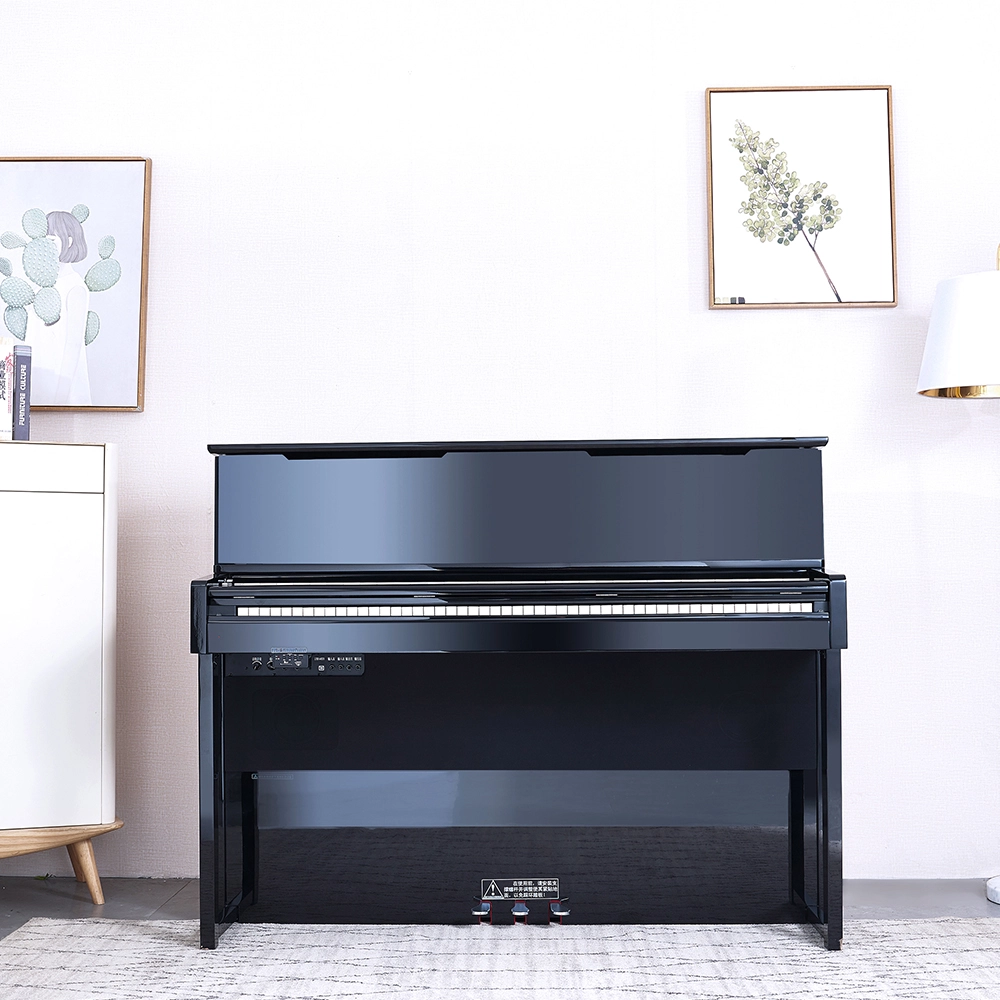
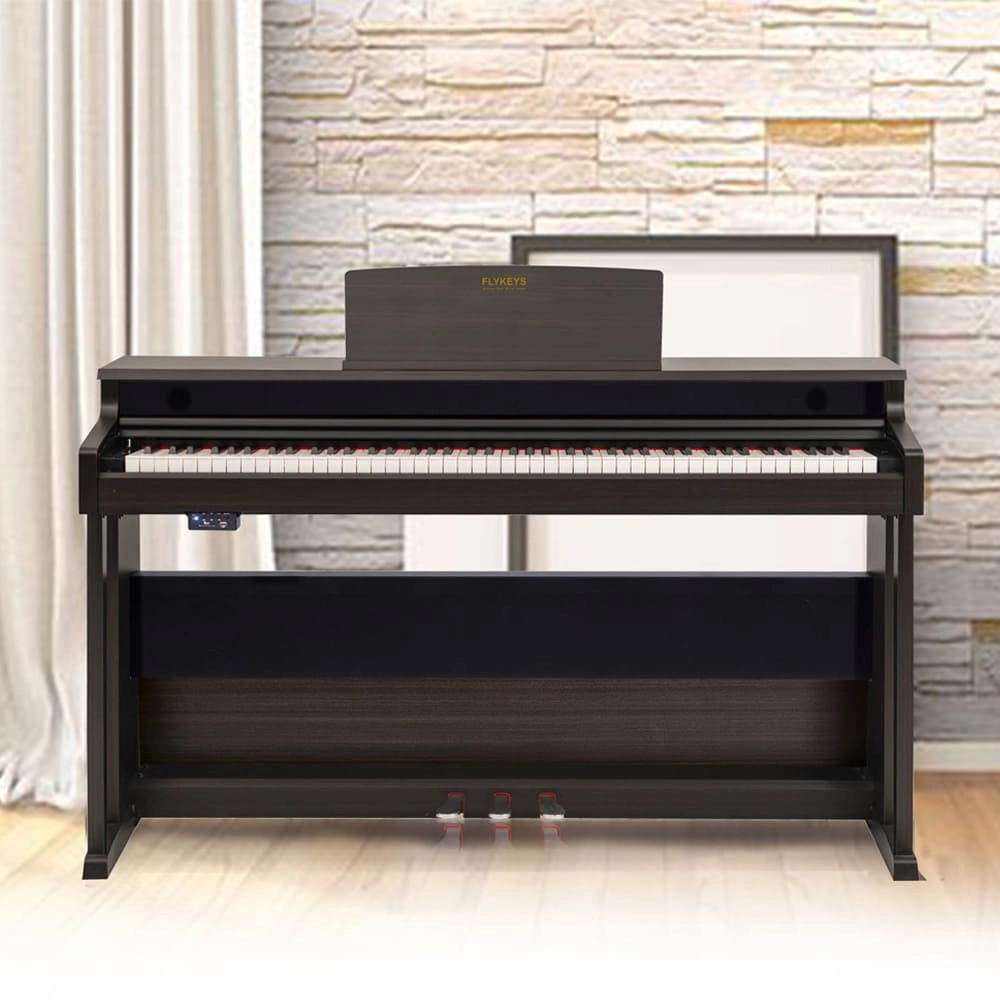
• Italian Fatar 88-key Grand-Response™ keybed with hammer action and dynamic touch curves
• Independently developed DSP chip with famous German grand piano sound sampling
• Independent speaker system with 360-degree surround sound effect
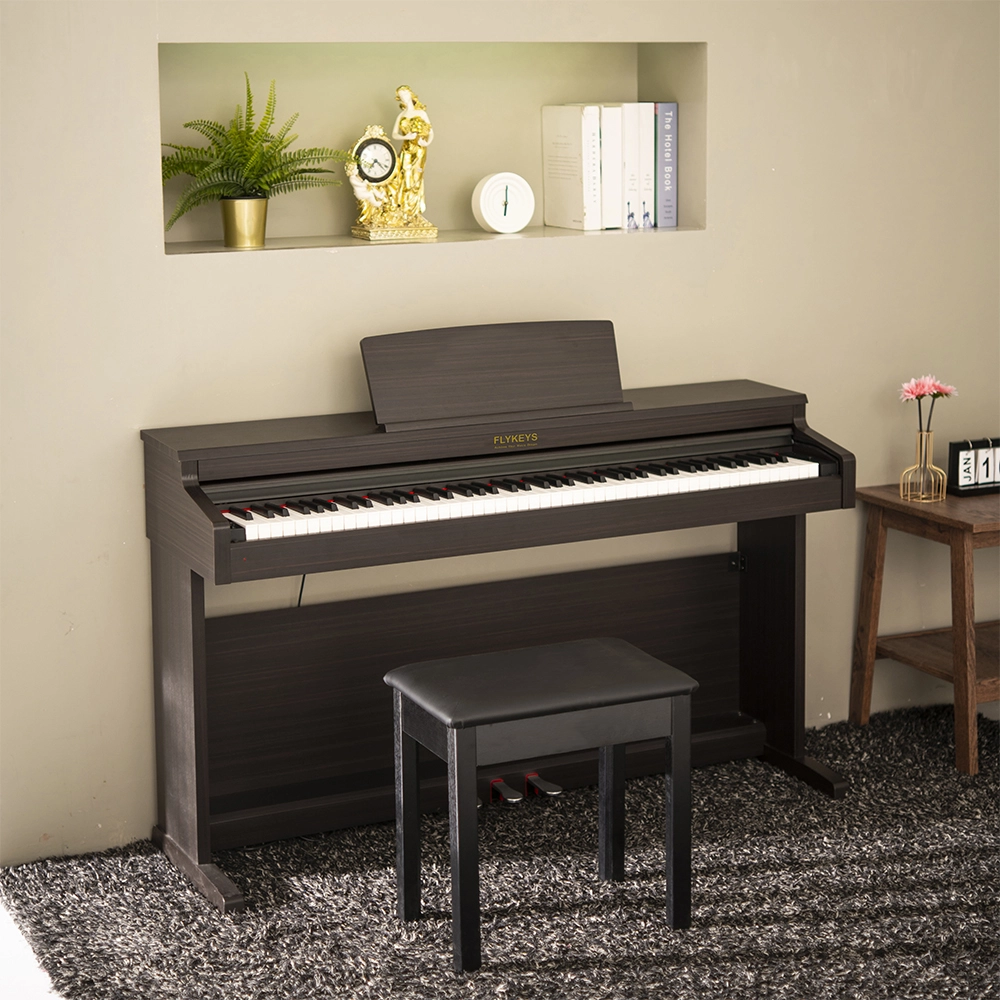
— Standard Upright Digital Piano
— Independent patented technology 88-key Grand-Response hammer-action & dynamic curve keyboard
— European top DSP chip, famous grand piano sound sample
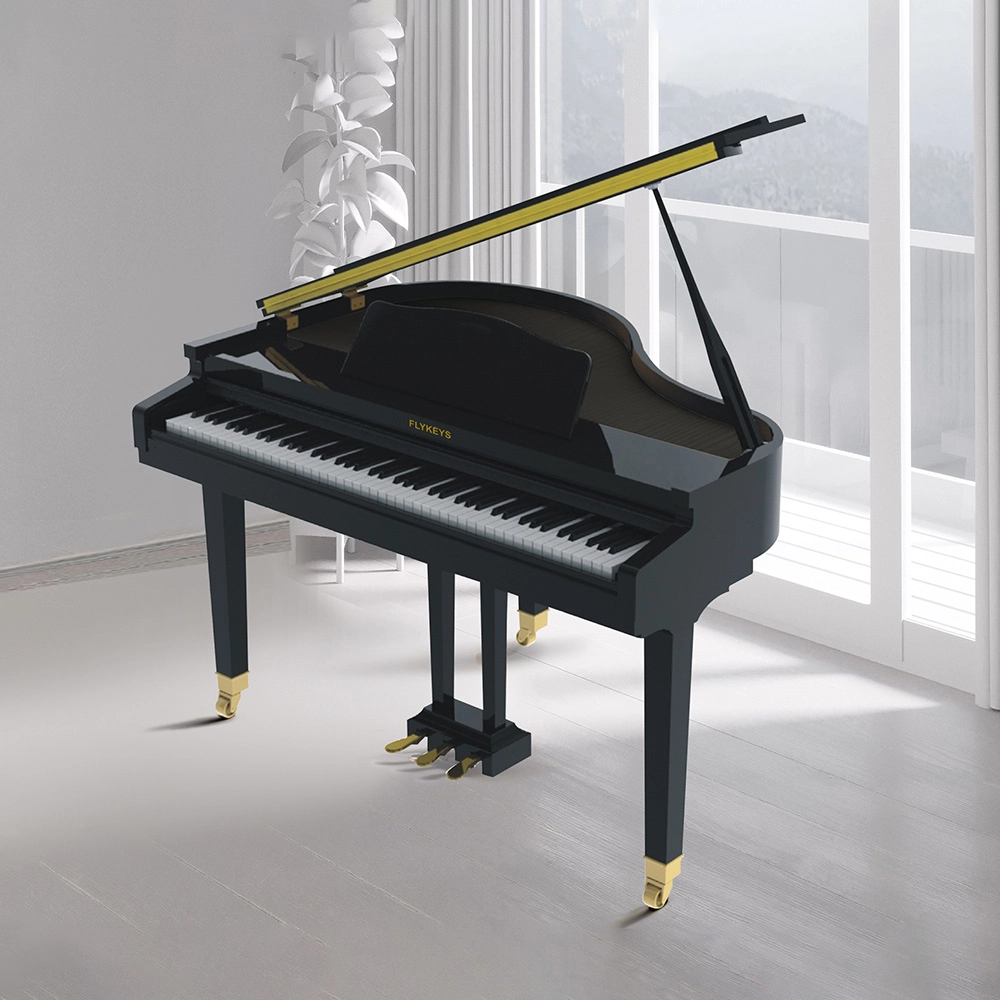
• Baby Grand Style with High-Gloss Polished Cabinet
• Italian Fatar 88-key Grand-Response™ Keyboard with Hammer Action and Touch Curve
• Independently Developed DSP Chip with German Grand Piano Sound Sampling
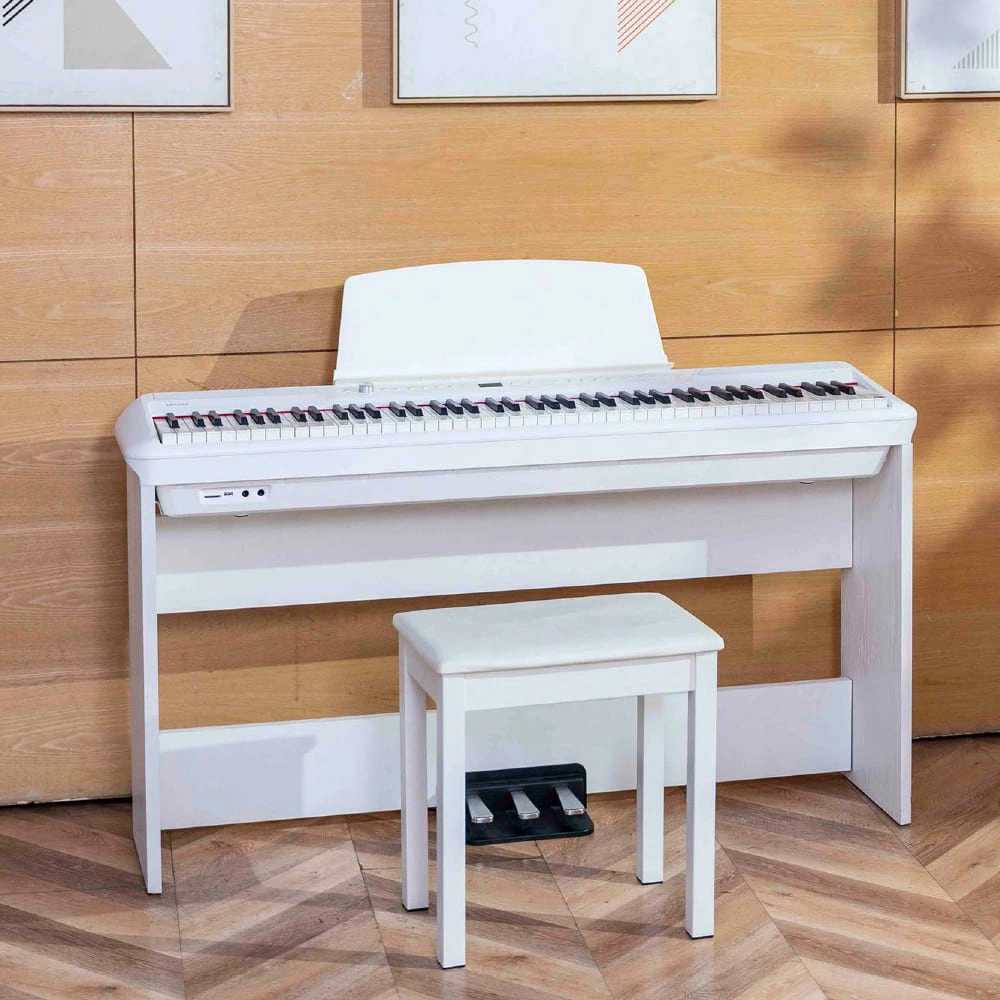
—keyboard: Independent patented technology 88-key, Grand-Response hammer dynamic curve keyboard
—Sound source: Independently developed the 4th generation DSP sound source, German famous grand piano sound sample
— Modern, lightweight case, X stand, U stand, Wood stand, 3 pedals
— Control: double sound, record, split, transpose, reverb, chorus, metronome, MIDI, bluetooth
Address: No. 38 Xiangshan Avenue, Zengcheng Economic And Technological Development Zone, Guangzhou, China.
FOLLOW US:
Copyright© 2026 FLYKEYS All Rights Reserved. 粤 ICP备2020102774号. Designed by Gooeyun. Sitemap | Privacy | Terms
FLYKEYS
FLYKEYS
flykeys-music
Flykeys Music