

Compact Upright Digital Pianos for Small Spaces
Modern residential living demands uncompromising spatial efficiency, yet serious pianists refuse to forfeit acoustic depth and authentic mechanical resistance. In my fifteen years advising acoustic designers and high-density urban apartment dwellers, selecting the best upright digital piano has shifted from a compromise between furniture footprint and musical authenticity to an exercise in cutting-edge electroacoustic physics. A compact upright digital piano engineered with high-density composite keybeds and modern physical modeling delivers the sonic nuance of a traditional acoustic instrument while occupying less than three square feet of floor space. By leveraging advanced algorithmic resonance and tailored speaker enclosures, current slimline designs bypass the phase cancellations and muffled low frequencies historically associated with positioning wooden soundboards directly against drywall.
Spatial Acoustics and Ergonomics in Compact Architectural Living
When clients consult me regarding piano placement in metropolitan studios or multi-use study rooms, the primary challenge is rarely the overall length of the instrument, but rather its depth profile and acoustic boundary loading. An 88-key instrument strictly requires roughly 130 to 140 centimeters in lateral width to preserve standard keyboard geometry, meaning architectural savings must be harvested from cabinet depth and low-frequency baffle tuning. In small rooms, placing an acoustic instrument against a boundary wall triggers severe acoustic room modes, frequently amplifying standing waves between 60 Hz and 150 Hz that muddy delicate passages.
Dimensional Constraints vs. Mechanical Keybed Physics
In traditional grand and upright instruments, extended key sticks provide the physical leverage necessary for consistent touchweight from the front lip of the ivory to the rear pivot point. When designing a compact instrument, mechanical engineers must dramatically reduce overall chassis depth—often targeting less than 35 centimeters—without shortening the key balance pin distance to the point where playing deep into the black keys requires excessive force. Throughout my technical evaluations of key actions, I have observed that modern graded hammer-action systems compensate for shorter cabinet profiles by deploying counterweighted dual-lever geometries. These compact mechanisms simulate the mechanical escapement of acoustic instruments without requiring the deep wooden back-chassis typical of traditional cabinet builds.
Resonance Modeling and Small-Room Wave Propagation
Placing an acoustic instrument in an enclosed urban space introduces substantial challenges in room coupling. According to fundamental principles documented in piano acoustics, the radiation pattern of a soundboard relies heavily on free air dispersion. When you compress an acoustic piano into a confined room, primary room modes create flutter echoes and unnatural mid-bass blooms. A high-grade compact upright solves this spatial limitation by deploying downward-firing and front-facing speaker arrays driven by intelligent equalization curves. Rather than relying on physical acoustic reflection from a monolithic soundboard, modern DSP algorithms dynamically shape lower-order harmonics, preventing the booming resonance that commonly degrades practice sessions in spaces under twenty square meters.
Speaker Enclosure Engineering in Shallow Cabinets
Achieving authentic low-frequency response within a shallow enclosure demands precise transducer engineering. In my acoustic teardowns of slimline digital uprights, the most successful designs isolate the mid-high frequency tweeters from low-frequency woofers using sealed acoustic chambers built from high-density fiberboard. By isolating the driver chambers, unwanted cabinet buzzes are eliminated during fortissimo playing. When downward-radiating subwoofers are paired with forward-slotted baffle vents, the player experiences both the visceral floor vibration reminiscent of a cast-iron plate and clear transient attack, even when the instrument is positioned completely flush against a domestic boundary wall.
How Modern Signal Processing and AI Transform Slim Keybeds
The traditional digital piano industry long relied on static audio sampling: recording multiple velocity layers of an acoustic concert grand and triggering them via mechanical contact switches. In my diagnostic work with audio interfaces, this approach continually falls short in compact living environments because static samples cannot replicate the dynamic inter-string resonances that occur inside a living, resonant chamber. Today, artificial intelligence and neural network-driven physical modeling engines synthesize vibrational mechanics in real time, calculating string coupling, damper lift impedance, and duplex scaling effects directly at the point of performance.
AI-Driven Polyphony Management and Physical Modeling
Modern synthetic sound production has evolved through machine learning models trained on millions of micro-acoustic interactions captured from master concert instruments. Research published through organizations such as the IEEE demonstrates that real-time neural modeling can simulate complex non-linear acoustic phenomena—such as sympathetic string resonance and sympathetic bridge transmission—with virtually zero latency. Rather than cutting off sustained notes abruptly when hardware polyphony limits are approached, modern AI allocation models prioritize fundamental frequencies and expressive overtones based on human psychoacoustic perception. When playing complex Rachmaninoff or contemporary jazz chords with the sustain pedal fully depressed, the instrument preserves harmonic sustain without synthetic dropouts.
Dynamic Velocity Curves and Tactile Sensor Calibration
A frequent issue I uncover during home studio audits is tactile mismatch: a player feels their physical strike does not correspond with the dynamic timbre emerging from the monitors. Advanced compact upright digital pianos now integrate high-speed optical or triple-contact sensor arrays calibrated by algorithmic velocity curves. These adaptive curve filters analyze a musician's individual touch profile over time, automatically compensating for environmental humidity or physical component fatigue. Standardized by the MIDI Association via modern high-resolution MIDI 2.0 communication protocols, this continuous micro-resolution tracking enables expressive nuance across 16,384 velocity steps, contrasting sharply with legacy 127-step MIDI limits.
| Comparison Factor | Traditional Approach | AI-Driven Approach |
|---|---|---|
| Polyphony and Voice Allocation | Hard-cutoff static sampling with fixed 128/256 voice limitations | Dynamic neural resource allocation prioritizing audible expressive overtones |
| Acoustic Space Compensation | Fixed hardware EQ sliders requiring manual tuning | Real-time acoustic modeling adapting output to room boundary reflections |
| Velocity and Tactile Tracking | Discrete 3-point velocity capture across standard 127 MIDI levels | High-resolution micro-sensing exceeding 16,000 algorithmic velocity increments |
| Sympathetic Resonance Behavior | Static loop crossfading that sounds sterile and repetitive | Dynamic physical simulation of inter-string friction, bridge transfer, and damper drag |
Selecting the Best Upright Digital Piano for Metropolitan Homes
Navigating the retail keyboard landscape requires looking beyond exterior aesthetic veneer. To find the best upright digital piano for a space-conscious home, you must critically examine keybed pivot mechanics, silent rehearsal headphone processing, and seamless home recording integration. A truly exceptional compact upright satisfies three foundational requirements: tactile mechanical feedback, spatial acoustic immersion at conversational volumes, and complete digital flexibility.
Evaluating Weighted Action: Graded Hammer vs. Real Wood
Throughout my comparative bench tests, key action remains the decisive factor separating entry-level hardware from professional instruments. Standard plastic keybeds often suffer from lateral wobble and excessive rebound noise—a nuisance that easily transmits through residential flooring into neighboring units below. When shopping for tight spaces, insist on graded hammer mechanics featuring synthetic ivory and ebony surfaces. These materials absorb fingertip perspiration during extended practice blocks while providing authentic micro-texture. Higher-tier slimline instruments incorporate real wooden key cores with graduated lead-free counterweights, ensuring that the bass octave possesses substantial mechanical resistance that transitions smoothly into light, agile responsiveness across the treble registers.
Headphone Spatialization and Silent Rehearsal
Urban living inevitably necessitates extensive headphone practice. Standard stereo panning inside headphones often induces cognitive listening fatigue within thirty minutes because the sound appears to localize directly in the center of the brain. When assessing contemporary upright digital pianos, I look for binaural acoustic sampling and spatial headphone modeling. By capturing sound fields using dummy-head microphones positioned at the player's ear level, the system simulates the sound stage of an open performance hall. This spatial imaging tricks the auditory cortex into perceiving the piano sound as emanating from the physical furniture piece in front of you rather than inside your headphones, enabling hours of focused midnight rehearsal without auditory strain.
Connectivity: Bluetooth Audio/MIDI and Home Studio Integration
In a compact apartment, your piano often doubles as a secondary work desk, MIDI master keyboard, and home entertainment speaker. Comprehensive connectivity is non-negotiable. Modern instruments must feature bi-directional low-latency Bluetooth MIDI and wireless audio streaming. This allows students and composers to pair tablets directly for interactive sheet music display, digital audio workstation (DAW) sequencing, and accompaniment playback without cluttering limited floor space with unsightly cabling. USB-to-Host audio interfaces built straight into the piano's internal sound engine enable pristine digital recording into your laptop without external preamplifiers or converter boxes.
Engineering Precision: Why Our Digital Piano Line Stands Out
Over the past decade and a half, my engineering team has focused on resolving the physical compromises inherent in small-footprint keyboard instruments. We recognized early on that urban players do not want an instrument stripped of tonal gravitas simply because their apartment lacks the expansive square footage required for a concert hall setup. By synthesizing advanced industrial design with proprietary physical modeling sound engines, we have developed an industry-leading instrument portfolio designed to thrive in modern interior architecture.
From Portable Digital Piano to Flagship Grand Digital Piano
Our comprehensive catalog is intentionally engineered to adapt to every phase of an artist's musical journey. For musicians living in mobile or multi-use studio settings, our Portable Digital Piano series provides uncompromised graded action within ultra-slim, ultra-rigid extruded aluminum frames that can be stowed effortlessly when not in use. When residential spaces demand a permanent decorative centerpiece, our Upright Digital Piano collection combines artisanal cabinetry with an exceptionally shallow footprint, delivering rich acoustic resonance without dominating your floor plan.
For high-end residential spaces and dedicated rehearsal studios seeking the absolute pinnacle of luxury performance, our Grand Digital Piano models incorporate hand-finished acoustic rims with our revolutionary multi-channel sound projection system. Simultaneously, our versatile studio Keyboards cater to electronic music composers and studio multi-instrumentalists who need rapid sound-layering, deep synthesizer synthesis, and flexible performance controllers without sacrificing keybed mechanical integrity.
Craftsmanship, Sustainable Materials, and Value Longevity
Every instrument we manufacture undergoes rigorous environmental stress testing to ensure long-term stability against seasonal temperature shifts and humidity swings—the natural enemies of acoustic soundboards. We use sustainably harvested timber for our wooden keybeds, paired with durable composite structural components that resist warping over decades of heavy technical use. Our proprietary DSP platforms are fully firmware-upgradable, protecting your investment by allowing your instrument's neural acoustic algorithms and voice libraries to evolve as sound synthesis technology advances.
Whether you are outfitting a compact high-rise apartment or upgrading a dedicated home recording suite, our specialists are ready to help you select the ideal instrument for your living space and artistic ambitions.
Frequently Asked Questions
What depth is considered compact for an upright digital piano?
A compact upright digital piano typically measures between 26 and 35 centimeters (10 to 14 inches) in total depth. This is roughly half the depth of a traditional acoustic upright, making it possible to position the instrument in narrow hallways, compact study rooms, or modern studio apartments without obstructing foot traffic.
Does a compact upright digital piano sacrifice key weight or action?
High-grade compact upright digital pianos do not sacrifice key weight. Instead of using shorter physical levers that create uneven resistance, premium instruments utilize folded graded hammer mechanisms and smart counterweight balances. This delivers authentic mechanical resistance and touch response while maintaining a shallow cabinet profile.
How does AI-assisted sound synthesis improve compact piano performance?
AI-assisted physical modeling replaces static acoustic sample loops with real-time dynamic simulation. It calculates inter-string sympathetic resonance, damper friction, and room boundary reflections continuously. This prevents the muffled, boxy tone common in small rooms and provides continuous dynamic expression without audible velocity stepping.
Can I use a compact upright digital piano as a master MIDI controller for a studio?
Yes. Modern compact upright pianos feature integrated USB-to-Host audio/MIDI and low-latency Bluetooth MIDI connectivity. They function as high-precision 88-key master controllers for Digital Audio Workstations (DAWs) and virtual instruments, providing authentic piano touch alongside modern digital production capabilities.
How much clearance does a compact upright need from the wall for optimal sound?
Unlike acoustic pianos that require 10 to 15 centimeters of wall clearance to allow the wooden soundboard to radiate sound freely, modern compact digital uprights are engineered with forward-facing and downward-directed speaker baffles. Most models can be placed completely flush against drywall or with a minimal 2 to 3 centimeter gap without compromising bass clarity or acoustic balance.

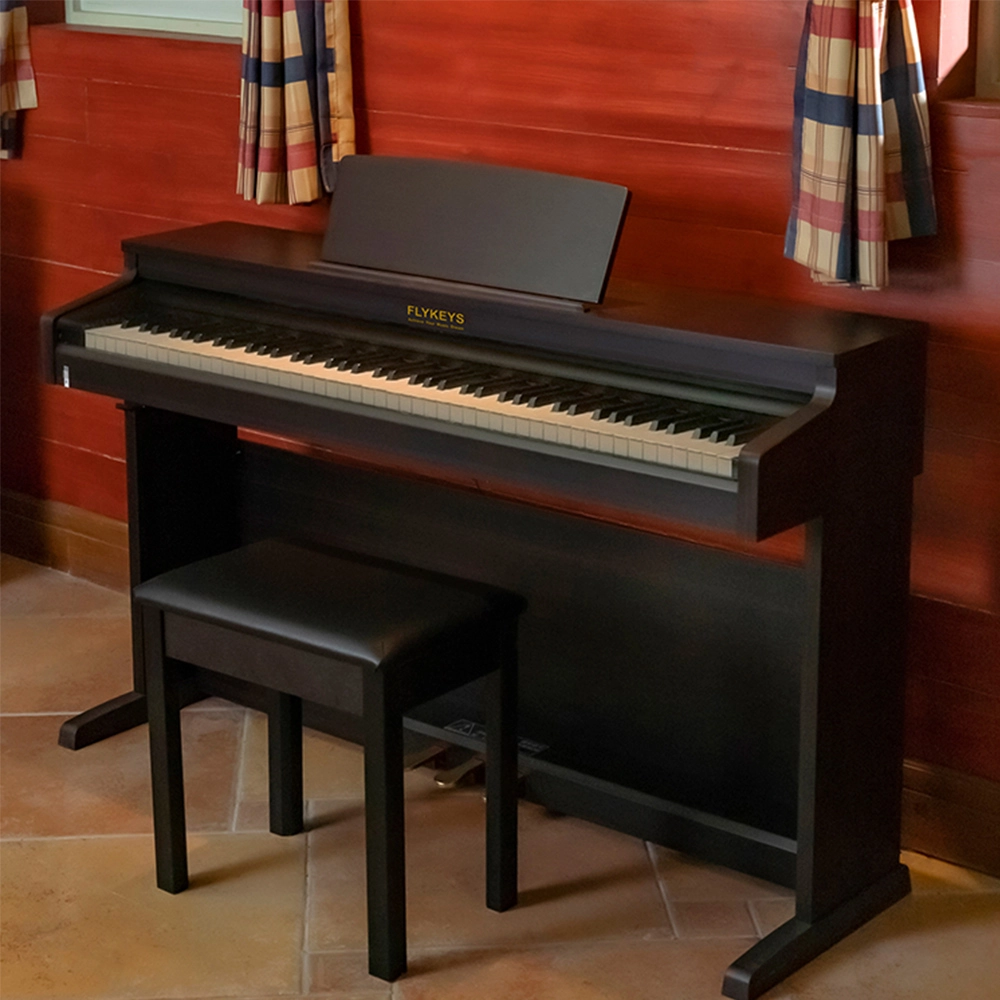
Sound Source: Independently developed DSP chip, famous German grand piano sound samples, 8-layer 256 MB dynamic wavetable, and string resonance and overtone simulation technology.
Keyboard: Independently developed 88-key weighted hammer-action keyboard with dynamic velocity curves.
Exterior: Small door design, wooden cabinet structure, sliding key cover, aluminum alloy handle, foldable large music stand, and side control panel with single-row round buttons.
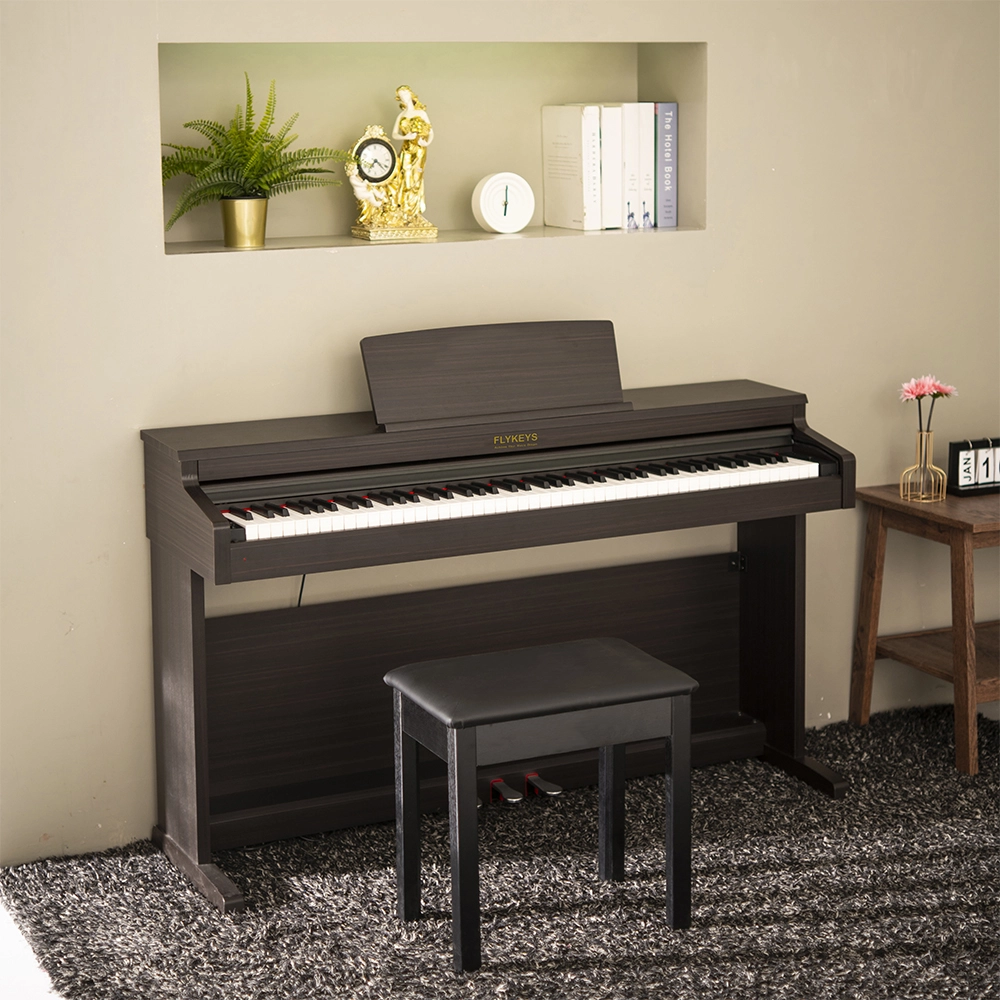
— Standard Upright Digital Piano
— Independent patented technology 88-key Grand-Response hammer-action & dynamic curve keyboard
— European top DSP chip, famous grand piano sound sample
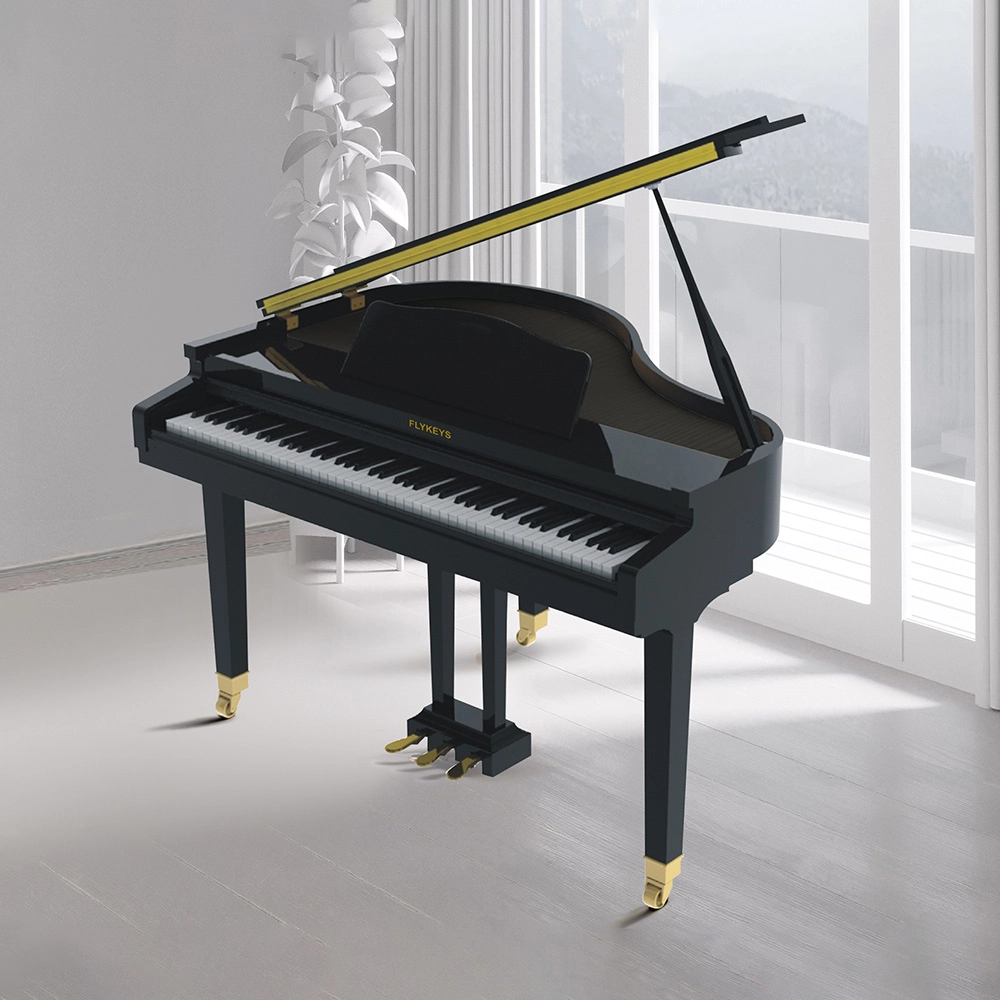
• Baby Grand Style with High-Gloss Polished Cabinet
• Italian Fatar 88-key Grand-Response™ Keyboard with Hammer Action and Touch Curve
• Independently Developed DSP Chip with German Grand Piano Sound Sampling
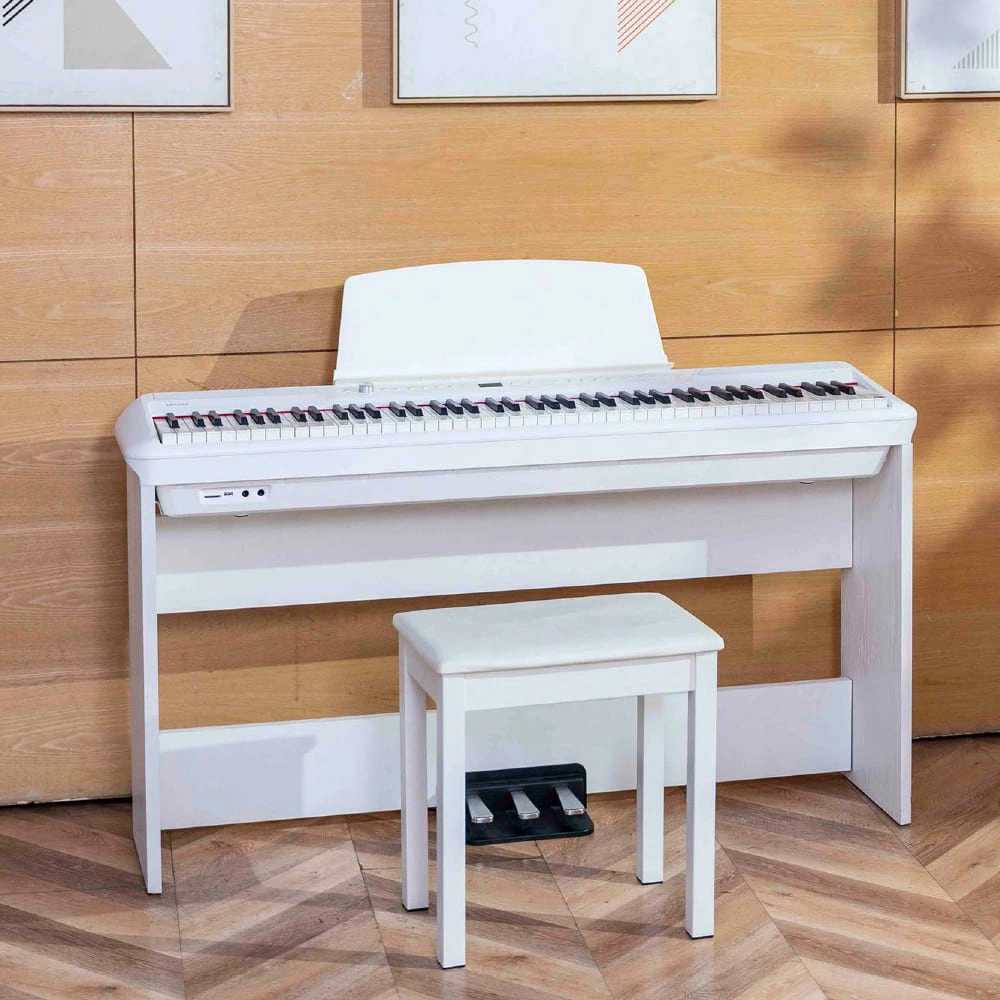
—keyboard: Independent patented technology 88-key, Grand-Response hammer dynamic curve keyboard
—Sound source: Independently developed the 4th generation DSP sound source, German famous grand piano sound sample
— Modern, lightweight case, X stand, U stand, Wood stand, 3 pedals
— Control: double sound, record, split, transpose, reverb, chorus, metronome, MIDI, bluetooth
Address: No. 38 Xiangshan Avenue, Zengcheng Economic And Technological Development Zone, Guangzhou, China.
FOLLOW US:
Copyright© 2026 FLYKEYS All Rights Reserved. 粤 ICP备2020102774号. Designed by Gooeyun. Sitemap | Privacy | Terms
FLYKEYS
FLYKEYS
flykeys-music
Flykeys Music