

How to Test a Digital Piano Before You Buy
Testing a digital piano requires a systematic approach to evaluating tactile response, acoustic authenticity, and technological integration. To ensure a digital piano keyboard beginners will find suitable, one must analyze the hammer action mechanics, polyphony limits, and the quality of multi-layered sampling. By focusing on the physical connection between the keybed and the sound engine, buyers can identify instruments that offer long-term durability and expressive range. Modern advancements in AI-driven sound modeling have further bridged the gap between digital and acoustic performance, making it essential to test how an instrument handles complex resonances and sustain decay during real-time play.
Evaluating the Tactile Response and Keybed Mechanics
The Importance of Graded Hammer Action
In my fifteen years of consulting for professional conservatories and home studios, I have found that the most critical factor for any digital piano keyboard beginners is the action. When I sit down to test a new model, the first thing I do is play a chromatic scale from the lowest A to the highest C. I am looking for a graded response—where the lower keys feel slightly heavier than the higher ones, mimicking the physics of an acoustic piano's hammers. According to the Wikipedia entry on piano action, the mechanical complexity of these systems is what allows for dynamic control. If the keys feel mushy or lack a distinct pivot point, your technique will suffer. I always recommend checking if the keys are made of synthetic ivory or ebony, as these materials provide the necessary friction to prevent slipping during intense practice sessions.
Testing Velocity Sensitivity and Dynamic Range
I often tell my clients that a digital piano is only as good as its ability to translate a whisper into a roar. To test this, I play a single note repeatedly, starting from the softest possible touch (pianissimo) and gradually increasing to the hardest strike (fortissimo). A high-quality digital piano should have at least 128 levels of velocity sensitivity, though many modern high-end models utilize sophisticated sensors to capture even more nuance. I look for a smooth transition between these volume levels. If you hear a sudden jump in volume or a change in tone that feels artificial, the sound engine's mapping is likely insufficient for serious study.
Key Return and Repetition Speed
For those looking at a portable digital piano or a keyboard, repetition speed is a common bottleneck. I perform a simple trill or a repeated note exercise. If the key does not return to its original position fast enough to be struck again, it will limit your ability to play advanced repertoire. This is often where cheaper models fail. I check for the presence of a triple-sensor system, which allows for note repetition without the key fully returning to the top, a feature standard in professional-grade instruments.
Analyzing Sound Synthesis and Acoustic Modeling
Sampling vs. Physical Modeling
When I evaluate the auditory output, I distinguish between traditional sampling and modern physical modeling. Sampling involves recording an actual grand piano at various intensities, while physical modeling uses mathematical algorithms to recreate sound in real-time. The IEEE has published numerous papers on digital signal processing that highlight how AI is now used to predict how strings vibrate in relation to one another. During my tests, I listen for looping in the tail of the note. In lower-quality keyboards, you might hear a short recording that repeats and fades out unnaturally. A High Quality instrument will have a long, natural decay that evolves over time.
Polyphony and Complex Textures
Polyphony refers to the number of individual notes or voices the piano can produce simultaneously. For a digital piano keyboard beginners might use, 64-note polyphony is the bare minimum, but I strongly advise 128 or 256. To test this, I hold down the sustain pedal and play a series of large chords and arpeggios across the entire keyboard. If the earliest notes start cutting off abruptly, the processor is reaching its limit. This is especially vital when layering sounds, such as piano and strings, which effectively doubles the polyphony requirement.
Sympathetic Resonance and Damper Noise
One of the hallmarks of a grand piano is how the other strings vibrate when you play a note. I test for this by silently holding down a C major chord in the middle register and then sharply striking a low C. In a high-quality upright digital piano, you should hear the middle C strings vibrating sympathetically. This level of detail is what separates a toy from a professional musical tool. I also listen for the subtle mechanical sounds of the damper pedal lifting, which adds to the immersive experience.
The Role of AI and Modern Connectivity in Piano Selection
We are currently witnessing a revolution in how digital instruments are designed. Artificial Intelligence is no longer just a buzzword; it is being used to analyze thousands of hours of concert grand performances to optimize how a digital piano responds to a player's unique style. In my experience, AI-driven sound engines provide a level of organic feel that was impossible a decade ago. These systems can adjust the tonal brightness based on the room's acoustics or the player's touch in real-time.
| Comparison Factor | Traditional Approach | AI-Driven Approach |
|---|---|---|
| Sound Generation | Static Multi-samples | Real-time Neural Modeling |
| Touch Adaptation | Fixed Velocity Curves | Adaptive Learning Sensors |
| Resonance Quality | Pre-recorded Reverb | Dynamic Sympathetic Calculation |
| User Calibration | Manual EQ Adjustments | Automated Room Correction |
As a consultant, I have seen how our brand has integrated these cutting-edge technologies to redefine the market. Our commitment to excellence is evident in every Portable Digital Piano and Upright Digital Piano we produce. We don't just build instruments; we engineer experiences. By utilizing high-resolution sensors and proprietary AI algorithms, our Grand Digital Piano line offers a level of realism that challenges the traditional acoustic market. Our Keyboards are designed with the same attention to detail, ensuring that even our entry-level models provide a professional foundation for students.
Our competitive advantage lies in our vertical integration. Unlike many competitors who outsource their sound chip production, we develop our own hardware and software in-house. This allows for a seamless connection between the physical key strike and the digital sound output, reducing latency to imperceptible levels. When you test one of our instruments, you will notice the connectedness—a term I use to describe the feeling that the sound is coming from the strings you are hitting, rather than a speaker. Whether you are looking for the space-saving benefits of a Portable Digital Piano or the majestic presence of a Grand Digital Piano, our technology ensures that you never have to compromise on touch or tone.
Furthermore, our instruments feature advanced Bluetooth MIDI and audio connectivity, allowing them to interface with the latest educational apps and DAWs. This makes our digital piano keyboard beginners' models particularly effective for modern learners who want to track their progress digitally. We have set a new industry standard by ensuring that even our most affordable Keyboards include features like string resonance and key-off samples, which were previously reserved for flagship models.
Please contact us today to find the perfect digital piano for your musical journey.
Frequently Asked Questions
What is the most important thing to check when buying a digital piano for beginners?
The most important feature is the 'weighted hammer action.' This ensures the keys feel like a real piano, which is essential for developing proper finger strength and technique.
How many notes of polyphony do I actually need?
For beginners, 64-note polyphony is acceptable, but 128-note polyphony is highly recommended to prevent notes from cutting off during complex pieces or when using the sustain pedal.
Is a portable digital piano as good as an upright model?
Modern portable digital pianos often use the same sound engines and key actions as upright models. The main difference is the speaker size and the aesthetic cabinet, but the performance can be identical.
Why does AI matter in a digital piano?
AI helps in creating more realistic sound modeling, allowing the instrument to respond dynamically to your playing style and simulating complex acoustic resonances in real-time.
Should I test the piano with headphones or speakers?
You should test both. Headphones allow you to hear the detail of the sound engine, while speakers let you feel the physical vibration and how the sound fills a room.
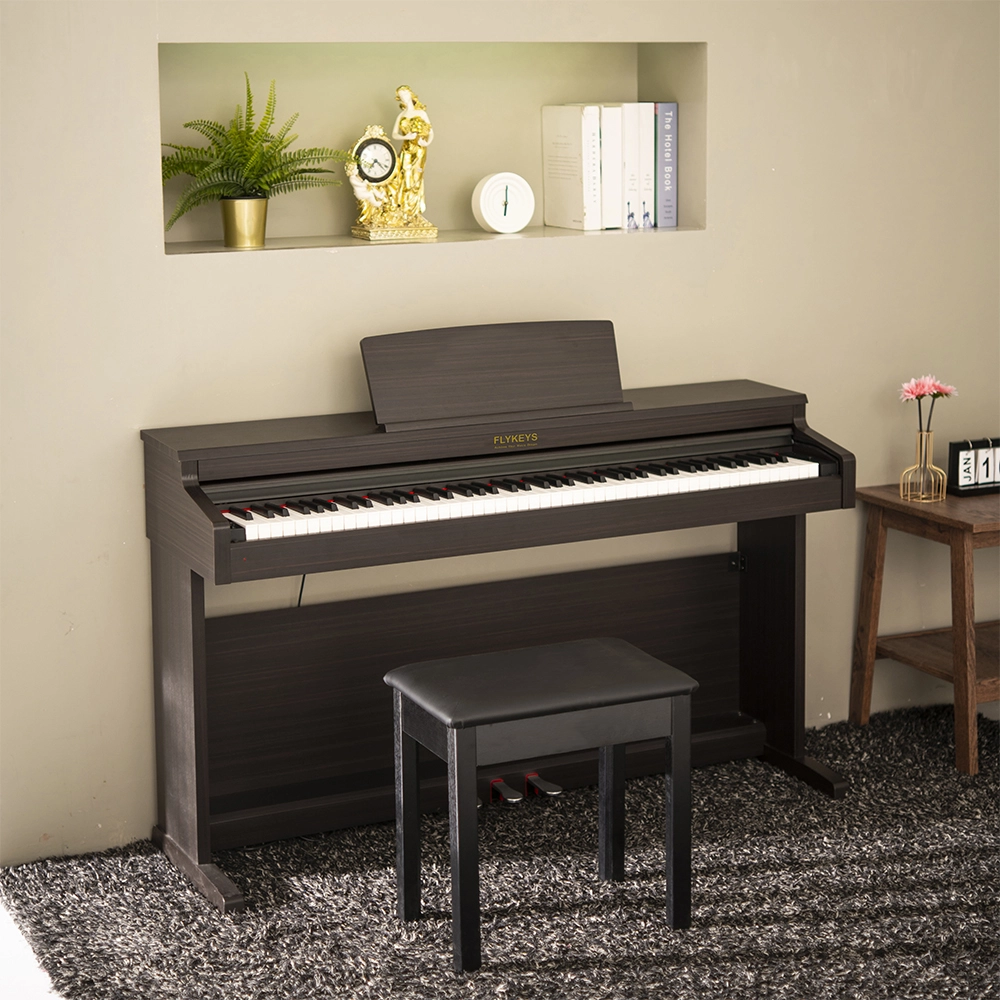
— Standard Upright Digital Piano
— Independent patented technology 88-key Grand-Response hammer-action & dynamic curve keyboard
— European top DSP chip, famous grand piano sound sample
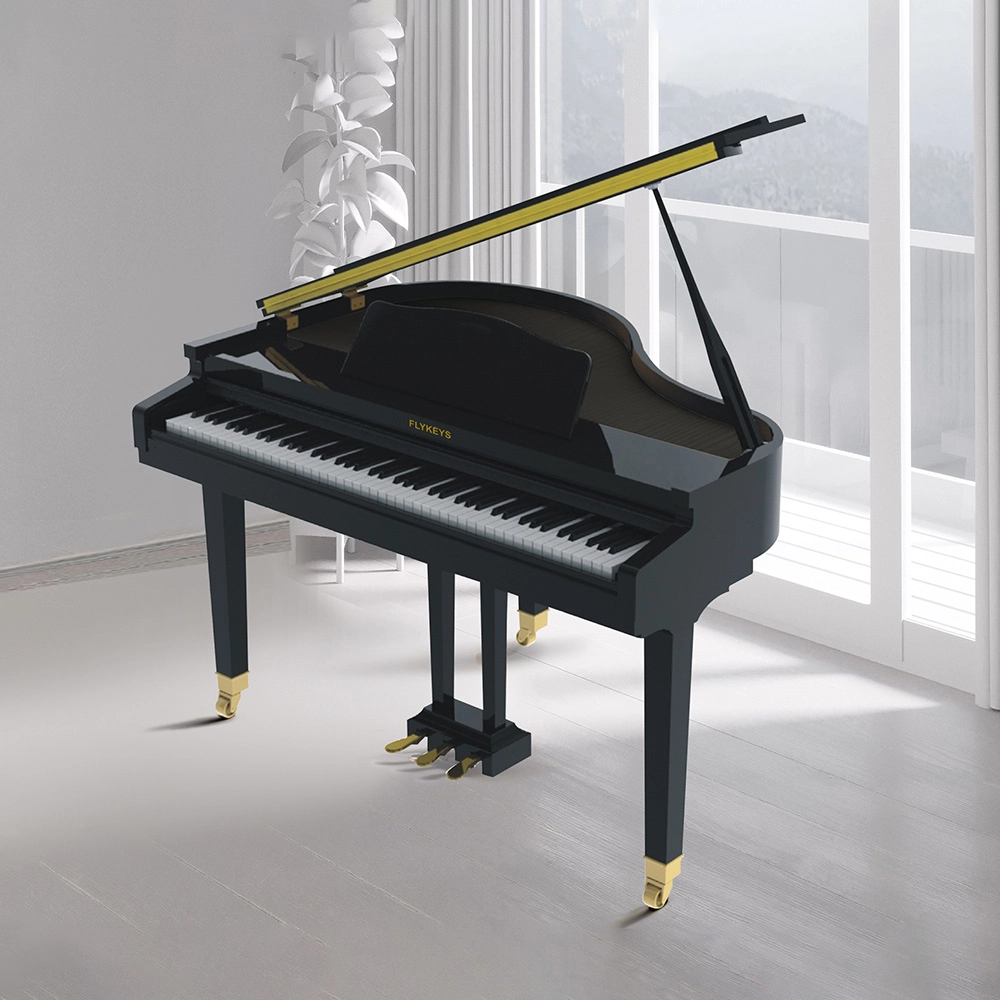
• Baby Grand Style with High-Gloss Polished Cabinet
• Italian Fatar 88-key Grand-Response™ Keyboard with Hammer Action and Touch Curve
• Independently Developed DSP Chip with German Grand Piano Sound Sampling
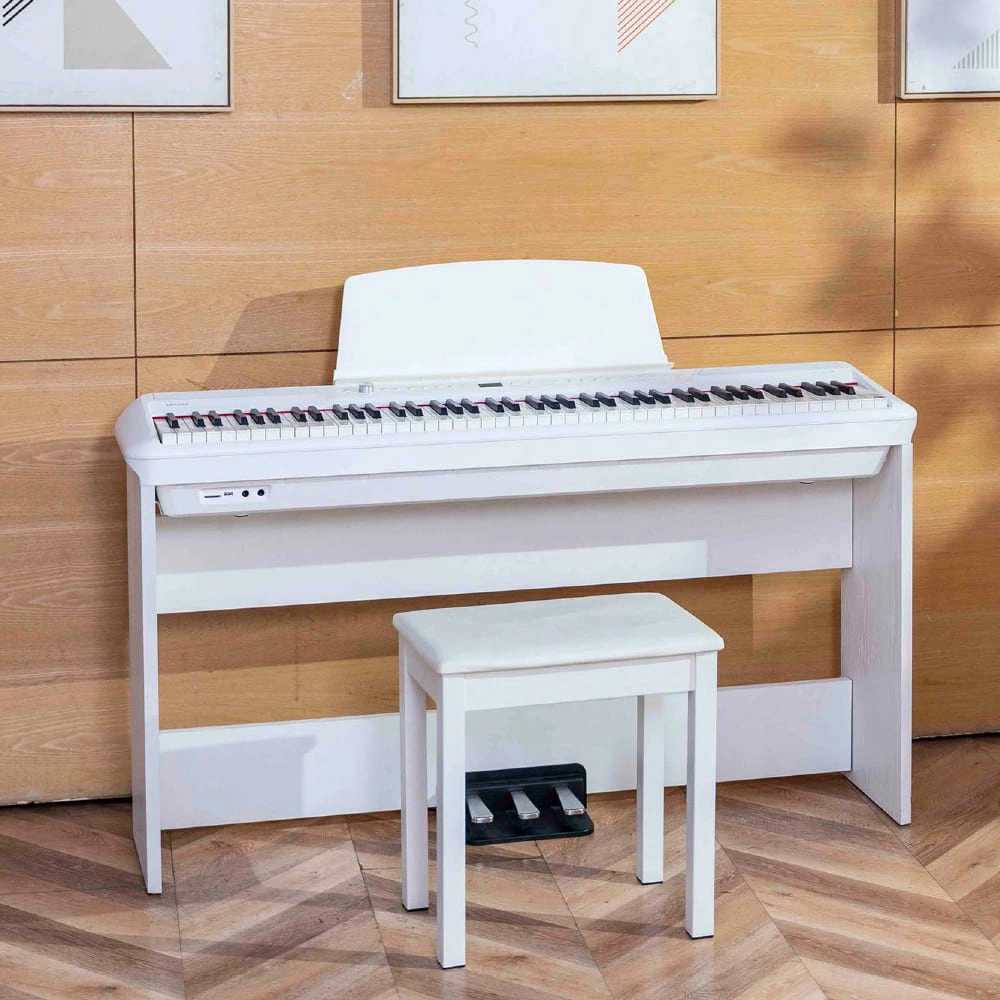
—keyboard: Independent patented technology 88-key, Grand-Response hammer dynamic curve keyboard
—Sound source: Independently developed the 4th generation DSP sound source, German famous grand piano sound sample
— Modern, lightweight case, X stand, U stand, Wood stand, 3 pedals
— Control: double sound, record, split, transpose, reverb, chorus, metronome, MIDI, bluetooth
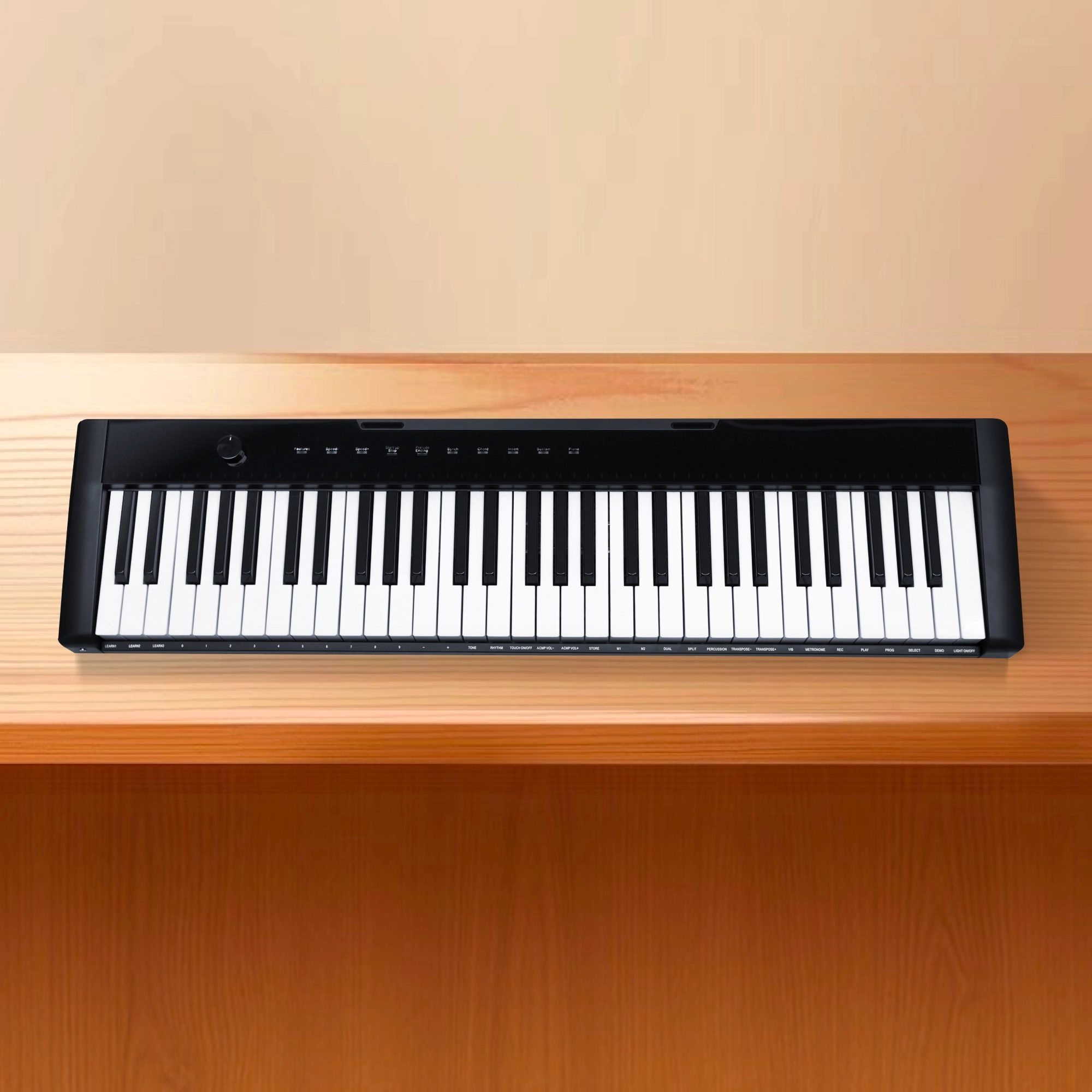
The keyboard features 61 touch-sensitive piano keys, 61 percussion sounds, 600 sounds, 100 demo songs, and 200 rhythms. It includes touch panel control with recording, programming, and playback functions, sync and fill-in functions, metronome function (master volume, accompaniment volume, and tempo control), sound expansion, vibrato, transpose, dual voice, and keyboard functions. Bluetooth and USB cable connectivity support connection with the learning app, which provides three learning modes: duet mode, continuous practice mode, and demonstration mode.
Address: No. 38 Xiangshan Avenue, Zengcheng Economic And Technological Development Zone, Guangzhou, China.
FOLLOW US:
Copyright© 2026 FLYKEYS All Rights Reserved. 粤 ICP备2020102774号. Designed by Gooeyun. Sitemap | Privacy | Terms
FLYKEYS
FLYKEYS
flykeys-music
Flykeys Music