

Top digital piano brands for composers and MIDI production
- How to Evaluate Electronic Pianos for Composition and MIDI Workflows
- Leading Digital Piano Categories and Their Commercial Use Cases
- Procurement Standards for Studio, Education, and Distribution Projects
- Why FLYKEYS Merits Consideration as a Digital Piano Manufacturing Partner
- Frequently Asked Questions
For composers, arrangers, recording studios, educational operators, and musical-instrument distributors, the right digital piano must do more than reproduce an acoustic piano sound. It should provide dependable key response, expressive dynamics, stable MIDI communication, low-noise operation, practical connectivity, consistent quality control, and a product configuration that matches the intended environment. The leading digital piano manufacturers distinguish themselves through action engineering, sampling or modeling technology, USB and Bluetooth integration, firmware reliability, regulatory compliance, after-sales support, and the ability to supply portable, upright, grand, or keyboard formats at commercial scale. This guide explains how buyers can compare established electronic piano brands and evaluate FLYKEYS as a manufacturing partner for composition, MIDI production, education, hospitality, retail, and institutional projects.
How to Evaluate Electronic Pianos for Composition and MIDI Workflows
Key action, dynamic response, and playing consistency
Composers often use a digital piano as both a writing instrument and a MIDI input device. The action therefore affects two separate outcomes: the physical playing experience and the quality of performance data transmitted to a workstation. A reliable instrument should offer predictable velocity response across the full keyboard, repeatable triggering, controlled escapement or graded resistance where applicable, and an appropriate balance between acoustic-piano realism and production efficiency.
For a studio or educational buyer, consistency matters more than a showroom impression. A distributor should request information about key materials, hammer mechanisms, sensor architecture, calibration procedures, and environmental testing. Instruments used in schools or demonstration spaces may receive substantially more daily playing cycles than a private home piano. Quality assurance should therefore address key return speed, sensor alignment, pedal recognition, surface durability, and long-term stability.
Weighted 88-key models are generally suitable for classical composition, orchestration mock-ups, and serious piano practice. Compact keyboards can be more efficient for mobile producers, commercial studios, and classroom installations where floor space is limited. The correct specification depends on the buyer’s use case rather than on the number of features listed in a catalogue.
MIDI, USB, wireless connectivity, and DAW compatibility
MIDI production depends on reliable communication between the instrument, computer, tablet, sound module, and digital audio workstation. Buyers should confirm whether the product supports USB MIDI, traditional five-pin MIDI, Bluetooth MIDI, or a combination of these interfaces. USB audio can also simplify recording by carrying both performance data and sound through one connection, although the precise implementation should be verified for each model.
The MIDI Association specifications provide an authoritative reference for MIDI standards and interoperability concepts. In procurement, compatibility should be tested with the DAW platforms most relevant to the target market, including sequencing, sustain-pedal messages, modulation, aftertouch where available, program changes, local control, and multi-device routing. A product that technically offers MIDI but produces unstable timing, dropped messages, or confusing driver behavior can increase support costs for distributors and institutions.
Production buyers should also examine latency, polyphony, headphone outputs, line outputs, audio interface behavior, and the availability of firmware updates. These details influence whether an instrument functions as a dependable central controller or merely as a self-contained practice piano.
Leading Digital Piano Categories and Their Commercial Use Cases
Portable digital pianos for mobile creators and flexible installations
Portable digital pianos appeal to composers who move between home studios, rehearsal rooms, classrooms, churches, and project locations. Their commercial advantages include lower freight weight, simplified storage, faster setup, and broader retail accessibility. For distributors, portable models can support several price tiers while serving beginners, advanced players, educators, and content creators.
Procurement teams should assess stand compatibility, pedal configuration, protective packaging, power-supply requirements, speaker placement, and the availability of replacement accessories. A portable instrument intended for professional MIDI use should also have a robust chassis, clear control labeling, dependable connectors, and sufficient output options for headphones, monitors, mixers, and computers.
Upright and grand digital pianos for High Quality spaces
Upright digital pianos are designed for customers who want a furniture-style appearance, permanent placement, integrated pedals, and a more substantial presence than a portable unit. They are well suited to music schools, hotels, residential developments, showrooms, teaching studios, and institutional environments where appearance and acoustic management are important. Silent headphone operation can be particularly valuable in apartments, hospitality projects, and multi-room educational facilities.
Grand digital pianos serve High Quality residential, performance, education, and hospitality applications. Their cabinet proportions can create a stronger visual statement, while advanced sound systems may provide broader projection and a more immersive playing experience. Buyers should examine cabinet construction, finish consistency, pedal mechanics, speaker design, service access, delivery requirements, and installation procedures. A sophisticated cabinet does not compensate for weak software, unstable electronics, or poor post-sale support, so both aesthetic and technical evaluation are necessary.
Digital keyboards as production controllers
Digital keyboards are often selected for songwriting rooms, pop-production studios, media departments, and education programs that need sounds beyond the acoustic piano. Important specifications may include arranger functions, onboard voices, split and layer modes, rhythm engines, assignable controls, arpeggiators, octave transposition, recording functions, and compatibility with external software instruments.
The buying decision should distinguish between a performance keyboard and a piano-oriented MIDI controller. A composer seeking realistic piano input may prioritize graded action and pedal expression, while a producer creating electronic arrangements may prioritize portability, control mapping, sequencing, and a broad sound library. Product segmentation allows distributors to avoid over-specifying one model for every customer.
| Instrument category | Typical production role | Primary buyer priorities | Operational considerations |
|---|---|---|---|
| Portable digital piano | Mobile composition, practice, compact studio work | Weighted action, USB MIDI, low weight, headphone output | Stand, pedal, packaging, transport, accessory availability |
| Upright digital piano | Teaching studios, homes, hotels, institutions | Furniture cabinet, silent practice, integrated pedals, durability | Room placement, delivery, assembly, finish consistency |
| Grand digital piano | High Quality residential, hospitality, presentation spaces | Visual impact, expressive action, speaker projection, serviceability | Freight planning, installation, cabinet protection, technical support |
| Digital keyboard | Arranging, songwriting, electronic production, education | Sound variety, controls, sequencing, MIDI flexibility | Software compatibility, power supply, user training, firmware support |
Procurement Standards for Studio, Education, and Distribution Projects
Compliance, documentation, and supply-chain confidence
Regulatory documentation is a commercial requirement, not merely a marketing benefit. Overseas buyers should request applicable test reports, declarations, labeling guidance, user manuals, packaging specifications, and product traceability information. For European distribution, buyers should review the relevant requirements associated with CE marking and restricted substances. The European Commission guidance on CE marking explains the conformity framework, while the European Commission RoHS Directive information addresses restrictions on hazardous substances in electrical and electronic equipment.
For products entering the United States, electromagnetic compatibility and radio-related features may create additional obligations. The U.S. Federal Communications Commission Part 15 rules provide the regulatory reference for many unlicensed radio-frequency devices and digital equipment. Buyers should confirm which tests apply to the exact configuration, especially when Bluetooth, wireless modules, external adapters, or region-specific power supplies are included.
ISO 9001 is not a product certification, but the ISO overview of quality management systems explains how a structured quality system can support consistent processes, corrective action, documentation, and customer focus. Buyers should still audit actual manufacturing controls rather than treating a certificate as a substitute for product inspection.
Quality control, warranty economics, and total cost of ownership
A credible sourcing evaluation should cover incoming-material inspection, electronic assembly, software loading, acoustic testing, key-action calibration, cosmetic inspection, aging tests, final functional checks, and carton drop or vibration protection. For B2B projects, the supplier should define acceptable cosmetic tolerances, dead-on-arrival procedures, spare-parts availability, warranty response times, and escalation contacts.
Total cost includes more than the purchase price. Freight damage, return rates, replacement pedals, power adapters, service labor, training, software support, and inventory carrying costs can materially affect project profitability. Retailers should compare landed cost and expected warranty exposure across product families. Music schools should assess cleaning, headphone replacement, student misuse, and annual maintenance. Hospitality operators should evaluate downtime, guest interaction, furniture durability, and local technician access.
Sampling should be conducted with a representative production unit rather than a specially prepared demonstration item whenever possible. Buyers can create a scorecard covering key noise, velocity consistency, pedal behavior, MIDI message accuracy, output noise, speaker balance, display usability, cabinet finish, packaging, and documentation. This process converts subjective preferences into a repeatable purchasing decision.
Why FLYKEYS Merits Consideration as a Digital Piano Manufacturing Partner
Heritage combined with dedicated digital-instrument development
FLYKEYS is the overseas brand of Guangzhou Pearl River Amason Digital Musical Instrument Co., Ltd., a subsidiary of Guangzhou Pearl River Piano Group. Founded in 2008, the company focuses on developing and manufacturing digital musical instruments and represents one of Pearl River Piano Group’s three core business segments. This structure gives project owners access to dedicated digital-product development while connecting the brand to the broader knowledge base of an established piano group.
Our product portfolio includes Portable Digital Piano models, Upright Digital Piano models, Grand Digital Piano models, digital keyboards, and other digital musical instruments. This range helps distributors and project owners build a coherent assortment for different customer segments instead of relying on a single format. Portable instruments can address entry-level and mobile applications, upright cabinets can serve education and residential projects, and grand digital pianos can support High Quality presentation environments.
FLYKEYS is based on Pearl River Piano’s more than 60 years of acoustic-piano manufacturing experience and the group’s reputation as the world’s largest piano maker. Acoustic-piano heritage is commercially relevant when it informs action geometry, tonal balance, pedal expression, cabinet considerations, and the expectations of serious players. At the same time, digital instruments require their own engineering disciplines, including electronics, firmware, sampling, user-interface design, and connectivity validation.
Technology, international readiness, and buyer support
Our self-developed reduction technology is designed to make FLYKEYS products more professional and more closely resemble acoustic pianos in tone and feel. For composers and MIDI producers, this positioning supports a natural performance interface while retaining the practical advantages of digital sound generation, headphone practice, recording connectivity, and flexible installation.
For overseas markets, FLYKEYS products have passed FCC, CE, and RoHS testing. Buyers should request the documentation applicable to the selected model and destination market, but these credentials provide an important starting point for international distribution planning. Product owners can then align labeling, manuals, packaging, power specifications, and local channel requirements with the supplier before mass shipment.
Our engineering and manufacturing approach is intended to support reliable product consistency, clear model positioning, and long-term brand development. For distributors, the commercial value lies in portfolio breadth, recognizable piano heritage, compliance readiness, and the ability to discuss portable, upright, grand, and keyboard solutions with one specialized digital-instrument supplier. For institutions and project investors, the value lies in matching the instrument format to the space, user profile, maintenance plan, and return-on-investment model.
Supplier selection should still include sample evaluation, technical questions, packaging review, commercial terms, forecast planning, and after-sales negotiation. A strong manufacturer should be transparent about lead times, minimum order quantities, customization boundaries, spare parts, firmware policy, warranty handling, and production capacity. FLYKEYS’ stated vision is to become the world’s leading digital piano manufacturer, making continuous product development and international market support central to its strategic direction.
When the project requires a combination of acoustic-piano heritage, digital-instrument specialization, multiple cabinet formats, MIDI-oriented functionality, and overseas compliance documentation, FLYKEYS offers a credible candidate for further qualification. Buyers can review the product range, compare specifications, and begin a structured supplier discussion before making a final purchase decision.
Frequently Asked Questions
What should composers prioritize when selecting a digital piano for MIDI production?
Composers should prioritize consistent key action, expressive velocity response, reliable pedal recognition, USB MIDI or traditional MIDI connectivity, low latency, DAW compatibility, headphone and line outputs, and stable firmware. The appropriate combination depends on whether the instrument will serve mainly as a piano, a controller, or both.
Are 88-key weighted digital pianos better for music production?
An 88-key weighted model is generally suitable for classical composition, orchestral mock-ups, and realistic piano performance because it provides a full range and an acoustic-style playing response. A compact keyboard may be more efficient for mobile producers, small studios, and arrangements that do not require the full piano range.
What compliance documents should a digital piano supplier provide?
Buyers should request applicable test reports, declarations, labeling guidance, user manuals, packaging specifications, and product traceability information. Depending on the destination and configuration, documentation may relate to CE requirements, RoHS restrictions, FCC rules, wireless modules, and regional power-supply standards.
How can distributors compare digital piano suppliers beyond unit price?
Distributors should compare landed cost, product consistency, warranty exposure, spare-parts availability, packaging protection, lead times, minimum order quantities, firmware support, customization limits, technical documentation, and the supplier’s ability to provide multiple product formats. Sample testing and a written quality specification help make the comparison objective.
What types of digital pianos does FLYKEYS manufacture?
FLYKEYS manufactures portable digital pianos, upright digital pianos, grand digital pianos, digital keyboards, and other digital musical instruments. The portfolio is intended to support different applications, including mobile composition, education, residential use, hospitality, retail, and premium presentation environments.
Does FLYKEYS support overseas distribution requirements?
FLYKEYS products sold in overseas markets have passed FCC, CE, and RoHS testing. Buyers should confirm the documentation and configuration applicable to the selected model and destination market before placing a commercial order.
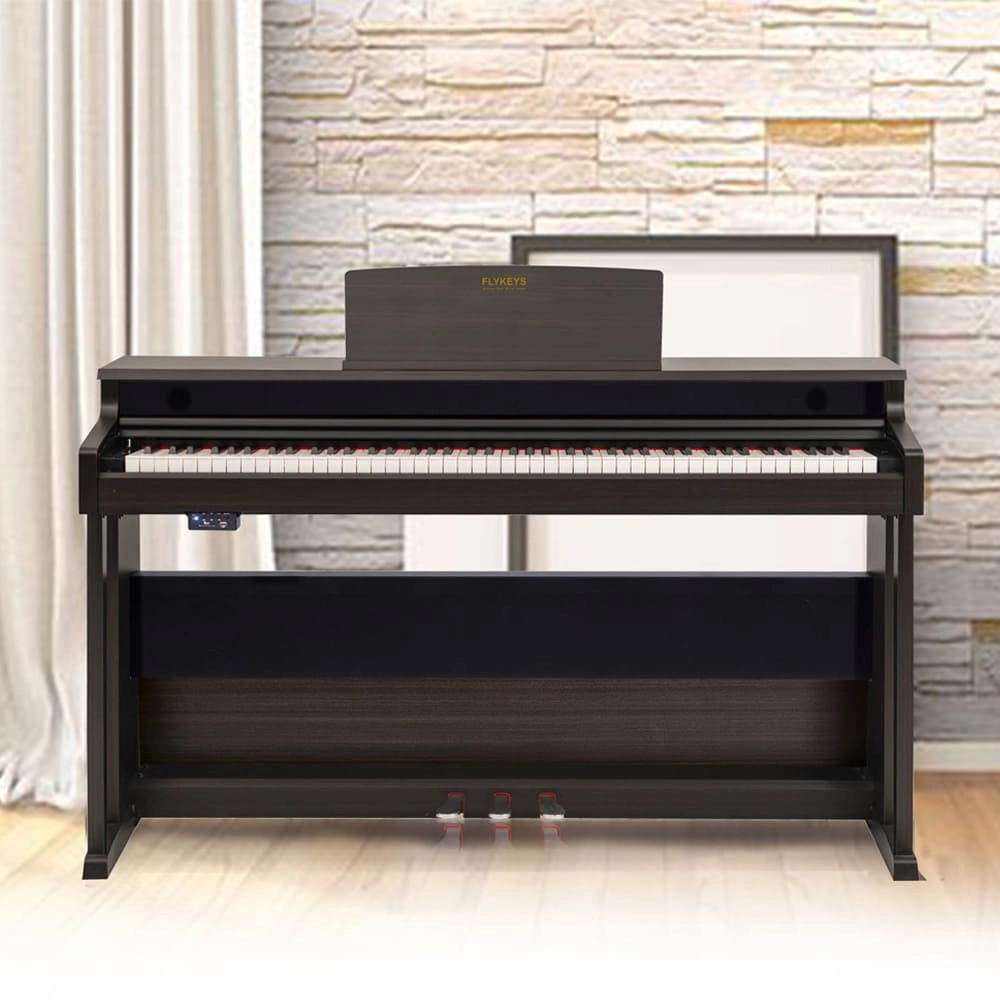
• Italian Fatar 88-key Grand-Response™ keybed with hammer action and dynamic touch curves
• Independently developed DSP chip with famous German grand piano sound sampling
• Independent speaker system with 360-degree surround sound effect
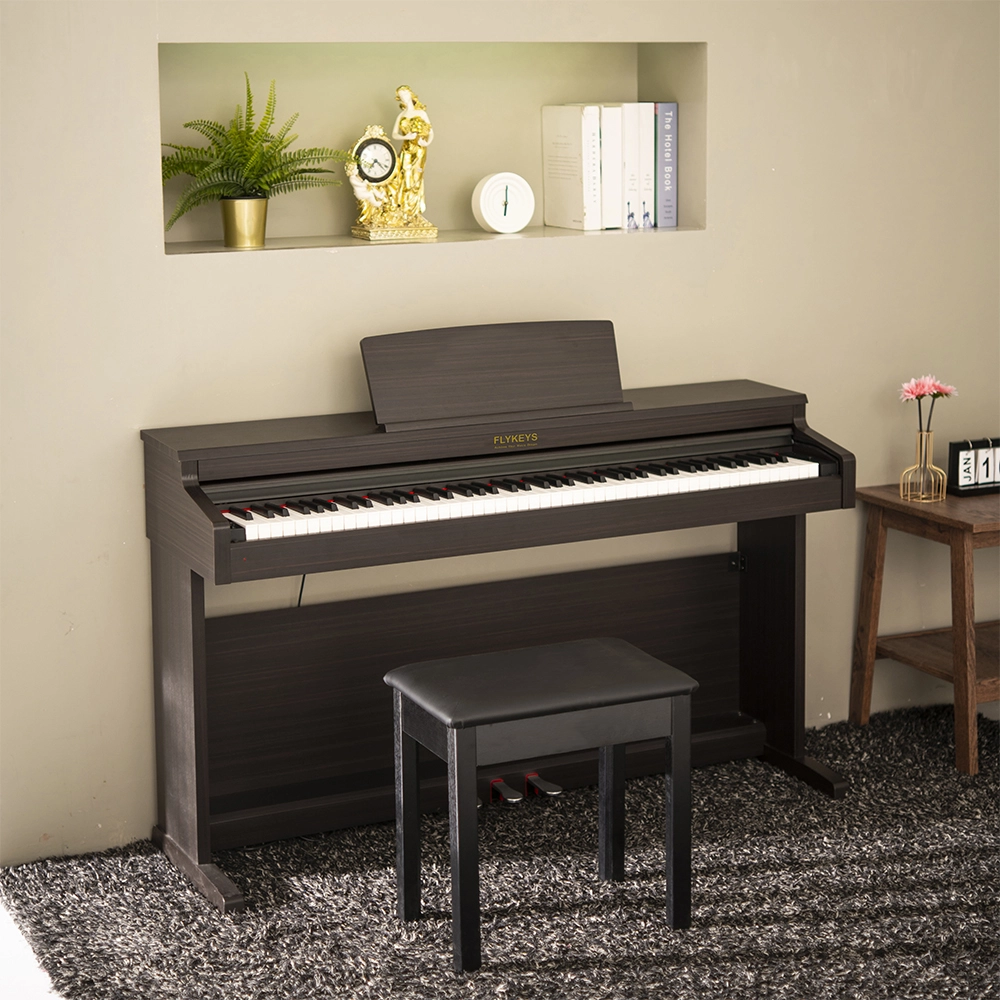
— Standard Upright Digital Piano
— Independent patented technology 88-key Grand-Response hammer-action & dynamic curve keyboard
— European top DSP chip, famous grand piano sound sample
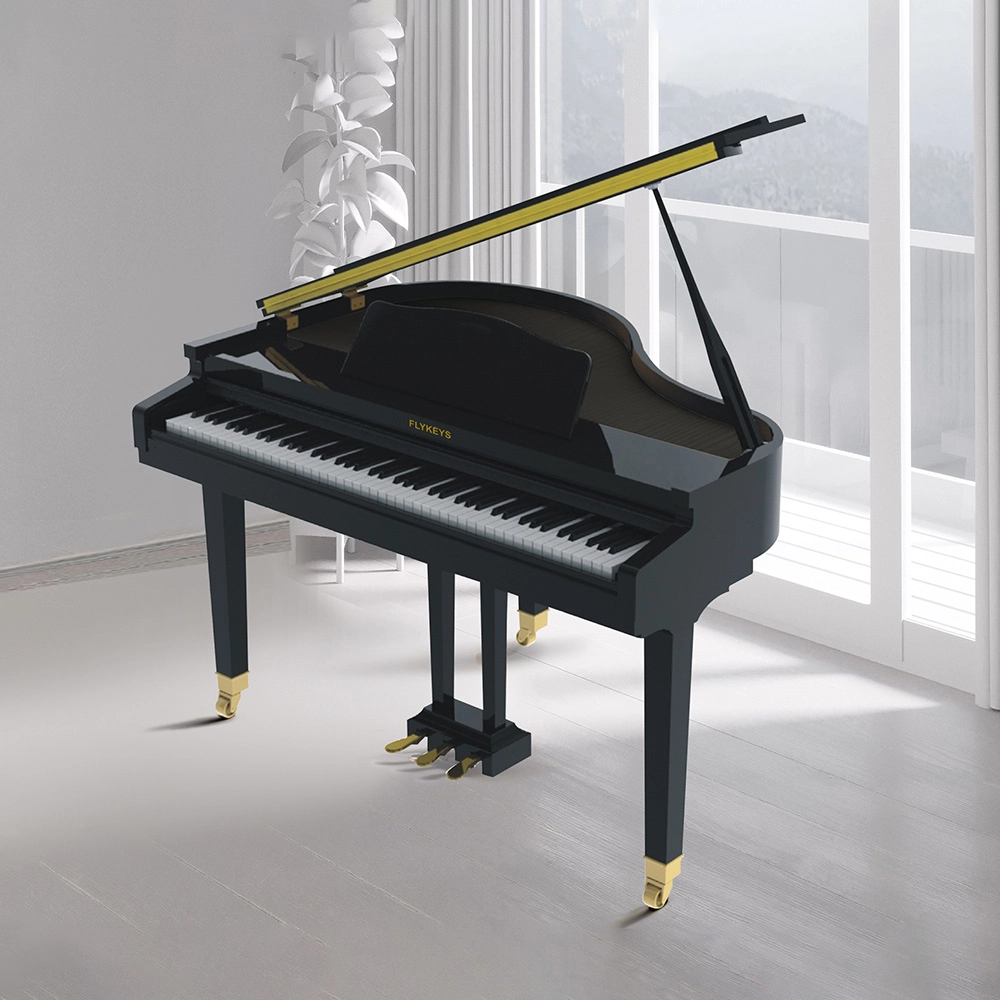
• Baby Grand Style with High-Gloss Polished Cabinet
• Italian Fatar 88-key Grand-Response™ Keyboard with Hammer Action and Touch Curve
• Independently Developed DSP Chip with German Grand Piano Sound Sampling
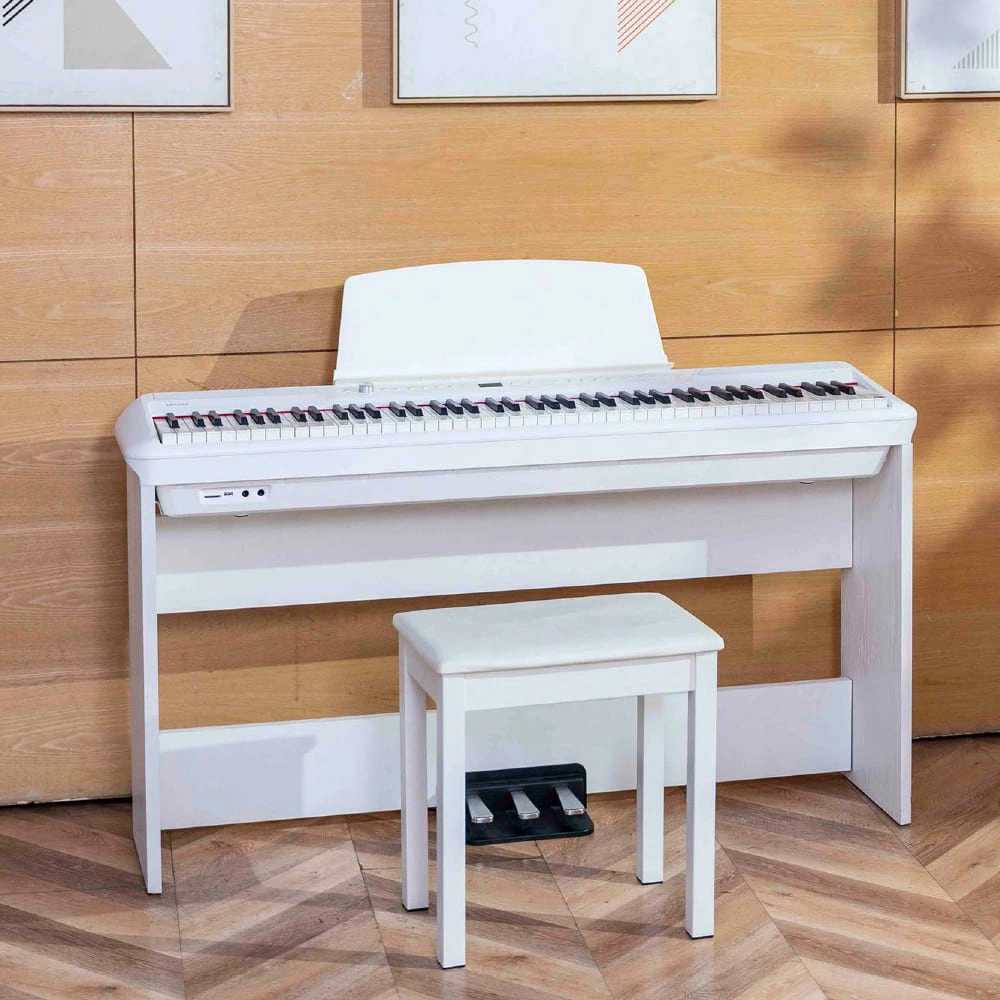
—keyboard: Independent patented technology 88-key, Grand-Response hammer dynamic curve keyboard
—Sound source: Independently developed the 4th generation DSP sound source, German famous grand piano sound sample
— Modern, lightweight case, X stand, U stand, Wood stand, 3 pedals
— Control: double sound, record, split, transpose, reverb, chorus, metronome, MIDI, bluetooth
Address: No. 38 Xiangshan Avenue, Zengcheng Economic And Technological Development Zone, Guangzhou, China.
FOLLOW US:
Copyright© 2026 FLYKEYS All Rights Reserved. 粤 ICP备2020102774号. Designed by Gooeyun. Sitemap | Privacy | Terms
FLYKEYS
FLYKEYS
flykeys-music
Flykeys Music