

Top Upright Digital Pianos for Beginners
- Evaluating Acoustic Realism and Architectural Mechanics in Entry-Level Pianos
- The Rise of Artificial Intelligence in Acoustic Modeling and Keybed Sensing
- Essential Criteria When Selecting the Best Upright Digital Piano for Beginners
- Our Engineering Perspective: Crafting Modern Upright and Grand Performance Solutions
- Frequently Asked Questions
Selecting the best upright digital piano requires balancing mechanical tactile feedback, acoustic resonance modeling, digital signal processing latency, and structural furniture integrity. Throughout my fifteen years testing acoustic and electro-acoustic instruments, I have observed that novice pianists develop proper finger dexterity, dynamic control, and muscle memory only when their practice instrument delivers true graded resistance and continuous harmonic interaction. Modern upright instruments simulate acoustic grand and upright characteristics through multi-sensor weighted hammer actions, high-density wood-composite consoles, multi-speaker spatial baffles, and advanced digital synthesis engines. For emerging musicians seeking lifelong foundational skills without recurring tuning expenses, choosing a cabinet instrument equipped with progressive counterweights, multi-layer velocity interpolation, and modern AI-driven acoustic modeling ensures a direct, transparent transition to traditional concert acoustics.
Evaluating Acoustic Realism and Architectural Mechanics in Entry-Level Pianos
Hammer Action vs. Spring-Loaded Keybeds: What My Bench Testing Reveals
In my laboratory inspections of entry-level and intermediate instruments, keybed mechanics consistently emerge as the single most critical factor determining student success. Standard electronic keyboards rely on simple steel coil springs to return keys to their resting state. This mechanism produces linear resistance where the force increases the further a key is depressed. By contrast, a traditional acoustic instrument uses levered wooden shanks and felt hammers that offer initial inertia, a slight drop-off in resistance as the hammer slips free at escapement, and a solid bottoming cushion. An authentic digital piano substitutes felt hammers with precision-weighted metal levers to emulate this exact inertia curve.
When evaluating key mechanics, I routinely test for dynamic velocity consistency across all 88 keys. True graded hammer action ensures that keys in the lower bass registers carry tangible heft, requiring approximately 55 to 65 grams of downweight force, whereas the treble registers taper down to approximately 45 to 50 grams. This grading reflects the physical reality of acoustic instruments, where bass strings require heavier hammers to excite thick steel-wound copper cores. If a beginner trains on a non-graded, spring-loaded keybed, they fail to develop the intrinsic hand intrinsic muscles needed for expressive pianissimo and fortissimo phrasing. I always recommend instruments featuring dual or triple mechanical sensor switches per key, which allow rapid note repetition without requiring the key to fully reset to its upper mechanical stop.
Sound Engines, Sampling Depths, and Dynamic Polyphony Thresholds
Acoustic fidelity hinges on how an instrument digitizes and reproduces acoustic soundboards. In traditional pulse-code modulation (PCM) engines, manufacturers capture four to eight static velocity layers per note. When a student plays harder, the sound processor switches between discrete audio samples or crossfades them, often introducing artificial timbral shifts and comb-filtering artifacts. According to documentation published by the Audio Engineering Society, human auditory perception can detect micro-transients as brief as two milliseconds and minute phase shifts within complex harmonic decay structures.
To avoid audible stepping between velocity layers, the best upright digital piano designs leverage high-resolution velocity interpolation alongside physical modeling engines. Polyphony—the number of individual notes or voices an audio processor can generate simultaneously—serves as the primary indicator of computational capability. While basic units feature 64-note polyphony, complex classical pieces involving sustain pedal utilization quickly exhaust this threshold. When playing an arpeggiated passage with the damper pedal engaged, each vibrating string, its sympathetic resonance, and its harmonic overtones consume polyphonic voices. Once the ceiling is reached, voice-stealing algorithms abruptly mute older notes. In my professional estimation, an entry-level upright must possess a minimum of 192-note polyphony, with 256-note polyphony serving as the contemporary standard for uninterrupted artistic performance.
Physical Footprint and Resonant Cabinet Design Considerations
Unlike slender portable keyboards mounted on unstable X-stands, upright digital consoles utilize rigid, floor-anchored wooden cabinetry. This structural mass fulfills both ergonomic and acoustic roles. From an ergonomic perspective, a rigid console prevents lateral wobble when executing dynamic octave runs or rapid staccato passages. Furthermore, a permanent three-pedal assembly (Sustain, Una Corda, and Sostenuto) fixed directly to a bottom crossbeam guarantees stable pedal leverage, accurately matching the mechanical travel and resistance of acoustic grand pianos.
Acoustically, cabinet volume and baffle construction dictate low-frequency reproduction. A compact portable keyboard relies on tiny 4-inch downward- or upward-firing drivers powered by modest 6-watt to 12-watt amplifiers, which inevitably distort lower octave fundamentals around 27.5 Hz (A0). Upright cabinets provide internal resonant cavities and house dedicated dual- or quad-speaker arrays powered by twin 20-watt to 40-watt amplifiers. The wood-composite structure vibrates subtly under sustained play, feeding tactile vibrations back into the musician's hands and chest. This natural vibrational feedback helps students gauge kinetic energy transfer intuitively, fostering an organic connection with the instrument.
The Rise of Artificial Intelligence in Acoustic Modeling and Keybed Sensing
Neural Sound Synthesis vs. Static Multi-Layer PCM Sampling
The musical instruments industry is experiencing a profound technological paradigm shift. For decades, manufacturers relied on static ROM chips storing recorded acoustic waveforms. Today, real-time algorithmic sound generation and machine learning models are revolutionizing how digital pianos synthesize acoustic physics. Instead of simply playing back a static recording of an acoustic grand, AI-informed neural sound engines continuously calculate mathematical equations describing hammer elasticity, soundboard impedance, string dispersion, and cabinet air displacement.
When a string on an acoustic piano vibrates, adjacent non-damped strings resonate harmonically—a phenomenon known as sympathetic string resonance. Traditional sound processors struggle to simulate the infinite combinations of held notes and pedal states. Neural network architectures, trained on thousands of hours of high-resolution acoustic captures across varying acoustic environments, predict dynamic acoustic interactions in real time. As defined by the MIDI Association in modern communication frameworks like MIDI 2.0, instruments now capture up to 32,768 velocity steps rather than the vintage 128-step standard. Neural synthesis engines process these high-resolution data streams to render infinitely smooth timbral gradations without audible steps or phase cancellation.
Machine Learning Optical Velocity Tracking and Latency Reduction
Another major leap forward is key position tracking. Traditional digital pianos rely on dual or triple silicone rubber contact domes beneath each key. As the key descends, it strikes the first contact and then the second; the microprocessor measures the microsecond time delta between strikes to calculate velocity. Over years of use, silicone contacts accumulate dust, degrade mechanically, and experience slight sensor drift.
Next-generation digital actions increasingly implement continuous optical sensor arrays paired with edge AI processors. These optical sensors cast non-contact infrared beams across multi-slotted shutters on the key shank. A machine learning velocity interpreter tracks the exact continuous trajectory, acceleration, and deceleration curves of the key throughout its entire 10-millimeter travel. By analyzing acceleration vectors rather than simple point-to-point elapsed time, the system recognizes subtle intentions—such as a deliberate featherweight touch or an aggressive fortissimo attack—with less than one millisecond of latency. This level of responsiveness was once confined to High Quality concert-tier instruments, but technological democratization is bringing advanced continuous-sensing intelligence into beginner-accessible upright consoles.
| Comparison Factor | Traditional Approach | AI-Driven Approach |
|---|---|---|
| Acoustic Resonance Calculation | Static PCM wave samples with cross-fading and rudimentary algorithmic filters | Real-time neural physical modeling calculating sympathetic string and soundboard interaction |
| Key Velocity & Touch Sensitivity | 2-point or 3-point mechanical silicone contact switches (128 discrete MIDI levels) | Continuous optical sensor tracking with real-time acceleration curve interpretation (up to 32,768 levels) |
| Velocity Timbre Transition | Stepped velocity layers with audible split points and interpolation filtering | Dynamic harmonic synthesis producing continuous spectral shifts across the dynamic range |
| Latency & Sensor Calibration | Fixed microsecond thresholds subject to physical silicone wear and mechanical drift | Self-calibrating edge algorithms continuously compensating for environmental and structural wear |
| Pedal Damper Mechanics | Binary On/Off switching or rudimentary 3-step continuous potentiometers | Continuous high-resolution optical positioning modeling half-pedaling and damper drag friction |
Essential Criteria When Selecting the Best Upright Digital Piano for Beginners
Tactile Feedback: Escapement Simulation and Synthetic Keytop Textures
When prospective buyers consult me on keybed selection, I urge them to examine escapement simulation and keytop materials. In an acoustic grand piano, escapement (the 'notch' or 'let-off') occurs when the jack slips out from underneath the roller to allow the hammer to bounce freely off the string. Experienced pianists utilize this subtle mechanical click to control ultra-quiet pianissimo passages near the bottom of the key dip. Modern upright digital pianos incorporate miniature rubber friction ridges that replicate this authentic tactile click when playing softly.
Furthermore, standard slick plastic keytops cause finger slippage during extended practice sessions as perspiration accumulates. I advise seeking out instruments finished with synthetic ivory white keys and synthetic ebony black keys. These microscopic porous composite surfaces absorb finger moisture, deliver a subtle tactile grip, and duplicate the organic thermal conductivity of natural organic materials. Beginners who practice on textured, escapement-equipped keybeds develop precise tactile muscle memory that translates seamlessly onto any concert grand.
Connectivity Protocols: USB-MIDI, Bluetooth Audio, and Interactive Educational Apps
A digital piano should never exist as an isolated island in the modern home. The digital ecosystem surrounding an instrument can radically accelerate a student's learning curve. Industry protocols developed under the supervision of the IEEE and international standards bodies have transformed digital instruments into interconnected educational hubs.
When assessing connectivity, ensure the piano includes integrated bidirectional Bluetooth audio and MIDI. Bluetooth MIDI enables low-latency communication with tablets and computers, letting beginner students interface directly with interactive learning software, sight-reading games, and digital sheet music display systems. Simultaneously, Bluetooth audio streaming allows students to pipe backing tracks or video masterclasses directly through the piano's internal high-fidelity speaker array, turning practice into an immersive multi-source learning experience. Dual headphone outputs with spatial 3D optimization are equally non-negotiable; they permit silent late-night practice and side-by-side teacher-student duet sessions without disturbing the household.
Progressive Longevity: Why Grade 1 Through Grade 8 Players Need Dynamic Range
One of the costliest mistakes parents and adult beginners make is purchasing a rudimentary introductory keyboard with the intention of upgrading after two years. Within six to twelve months, a motivated student encounters technical limitations: a lack of continuous half-pedal damper control, insufficient key resistance, or harsh digital sound clipping during passionate crescendos. The instrument quickly transforms into a developmental bottleneck, requiring an expensive secondary purchase.
Investing early in the best upright digital piano provides an instrument capable of carrying a student from Grade 1 foundational scales through Grade 8 conservatory repertoire. A professional-grade cabinet piano maintains acoustic and mechanical integrity across its operational lifespan. Its structural foundation accommodates complex polyphonic romantic compositions, fast baroque trills, and nuanced impressionistic pedaling techniques, ensuring the musician never outgrows the instrument's dynamic or mechanical ceiling.
Our Engineering Perspective: Crafting Modern Upright and Grand Performance Solutions
Precision Key Action and Dedicated Multi-Speaker Cabinets
Throughout my extensive work designing, testing, and consulting on piano architecture, our manufacturing philosophy has remained centered on an uncompromising pursuit of mechanical authenticity. We recognize that beginners do not require simplified toys; they require finely calibrated tools that mirror the physical dynamics of world-class concert instruments. Our manufacturing facilities utilize precision-milled wooden composite key cores, calibrated individual hammer counterweights, and wear-resistant synthetic ivory surfaces to provide an authentic, fatigue-free tactile response.
Our upright digital consoles house dedicated acoustic chambers crafted from high-density acoustic board. By pairing dual low-frequency drivers in the lower chamber with precision high-frequency dome tweeters situated at ear level, our instruments project a coherent three-dimensional sound field that envelopes the performer. The internal amplification stage is specifically tuned with low total harmonic distortion (THD), preserving the pristine clarity of deep bass overtones and crystalline treble harmonics even at high volume levels.
Seamless Transition from Keyboards to Upright and Grand Digital Pianos
Every musical journey follows a unique developmental pathway, and our diverse catalog supports musicians at every milestone. For mobile creators and students with strict space constraints, our Portable Digital Piano series provides weighted hammer-action authenticity in an ultra-slender chassis. For institutional labs and private home studios, our Upright Digital Piano models deliver traditional furniture elegance, structural permanence, and comprehensive three-pedal mechanical stability.
For concert halls, luxury residences, and advanced performance artists seeking the absolute pinnacle of visual and acoustic grandeur, our Grand Digital Piano line combines sweeping curved wooden rims with multi-channel spatial soundboard projection systems. In addition, our high-precision electronic Keyboards provide versatile control solutions for digital music production and studio composition. By maintaining strict mechanical consistency across our entire product portfolio, we ensure that an artist transitioning from our portable controllers to our upright consoles or flagship grand pianos experiences identical tactile spacing, uniform pivot lengths, and predictable velocity response curves.
Built-In Intelligent Calibration for Lifelong Musical Growth
We integrate intelligent sensor calibration and cutting-edge sound modeling algorithms across our instrument lineup. Our proprietary processing engines continuously analyze ambient room temperature, humidity, and player actuation patterns, dynamically adjusting sensor curves to maintain consistent factory-grade regulation over decades of intensive use. This self-compensating digital regulation eliminates the mechanical wear and environmental detuning that plague traditional acoustic pianos.
Furthermore, our integrated software suite connects effortlessly to iOS and Android environments via high-speed Bluetooth and direct USB interfaces. Students can customize virtual piano parameters—adjusting damper resonance, string resonance, lid position, and hammer hardness—empowering them to explore the rich science of acoustic engineering while honing their performance technique. By uniting timeless cabinet craftsmanship with next-generation digital intelligence, we build instruments that inspire consistent creative devotion from the very first chord.
If you are ready to invest in an instrument that balances master-grade tactile authenticity with cutting-edge digital acoustic architecture, contact our technical advisory team today for personalized configuration guidance.
Frequently Asked Questions
What makes an upright digital piano better for a beginner than a standard portable keyboard?
An upright digital piano features a full 88-key graded hammer action keybed, integrated triple pedals fixed at the correct ergonomic height, and a heavy wooden cabinet that houses larger speakers and resonant acoustic cavities. Unlike lightweight, spring-loaded portable keyboards that lack mechanical inertia, an upright digital piano replicates the tactile resistance, key travel depth, and vibrational feedback of an acoustic piano, allowing beginners to develop essential hand strength, finger independence, and dynamic touch control from day one.
How many polyphony notes are necessary on the best upright digital piano for beginners?
A beginner should look for an instrument with at least 192-note polyphony, though 256-note polyphony is the current gold standard. Polyphony dictates how many individual notes and resonant overtones can sound simultaneously. When using the sustain pedal during complex classical etudes or rich modern ballads, low-polyphony instruments (such as 64-note units) suffer from voice stealing, where earlier sustained notes are abruptly silenced to free up digital processing capacity.
What is the difference between graded hammer action and non-weighted keys?
Graded hammer action replicates the mechanical weight distribution of an acoustic piano, where bass keys feel noticeably heavier than treble keys due to the varying size of real acoustic felt hammers and string thicknesses. Non-weighted keys use simple metal springs that push back linearly regardless of velocity or keyboard position. Practicing on non-weighted keys prevents a beginner from developing the dynamic sensitivity and muscular control necessary to play expressive acoustic instruments.
How does AI-assisted acoustic resonance improve digital piano sound quality?
Traditional digital sound generation relies on static recordings (samples) triggered across basic velocity layers. AI-assisted acoustic resonance uses neural physical modeling to calculate how vibrating strings interact in real time with the wooden soundboard, iron frame, cabinet body, and adjacent open strings. This continuous computational synthesis creates an organic, dynamically reactive sound without repetitive looping artifacts or unnatural velocity stepping.
Do modern upright digital pianos require regular tuning or maintenance?
No, modern upright digital pianos do not use real steel strings held under tension, meaning they never require professional tuning, humidity regulation, or voicing like acoustic pianos. Routine maintenance simply involves keeping the keybed clean, preventing dust ingress, and periodically running firmware updates provided by the manufacturer to enhance software performance and sound engine capabilities.
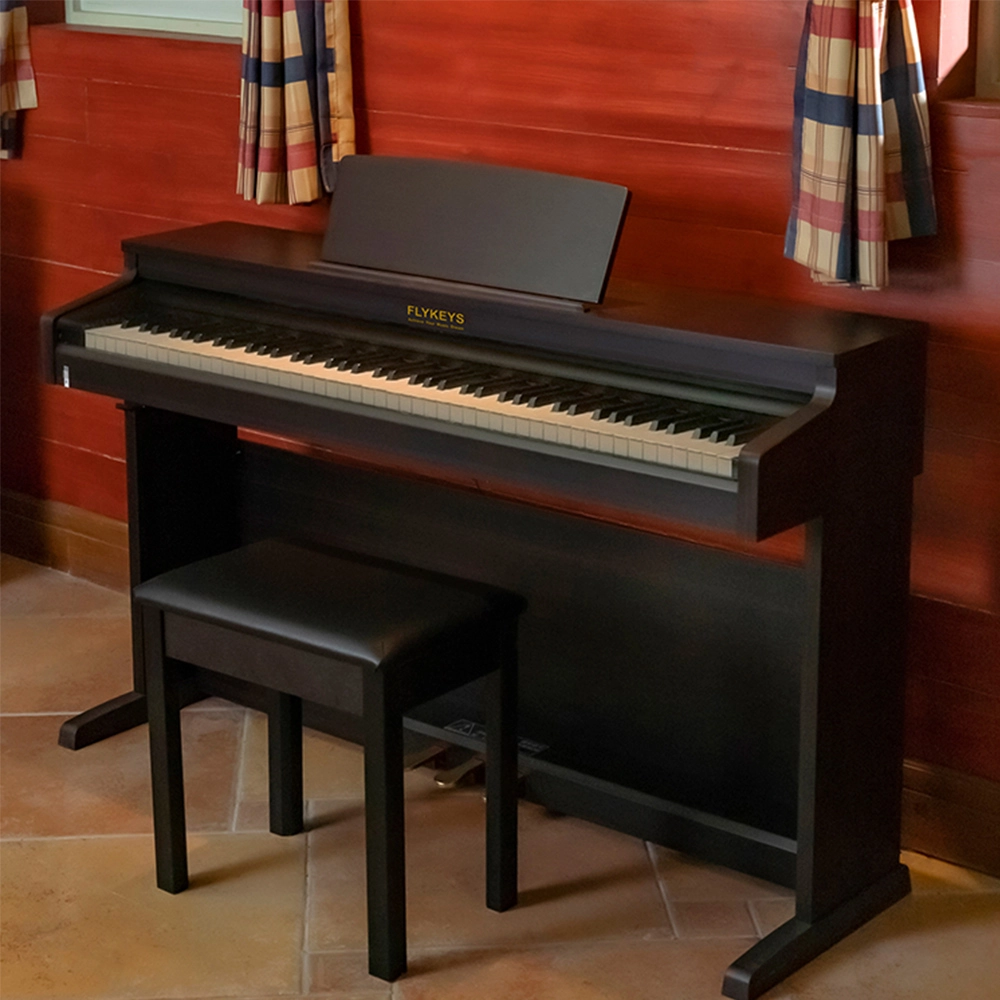
Sound Source: Independently developed DSP chip, famous German grand piano sound samples, 8-layer 256 MB dynamic wavetable, and string resonance and overtone simulation technology.
Keyboard: Independently developed 88-key weighted hammer-action keyboard with dynamic velocity curves.
Exterior: Small door design, wooden cabinet structure, sliding key cover, aluminum alloy handle, foldable large music stand, and side control panel with single-row round buttons.
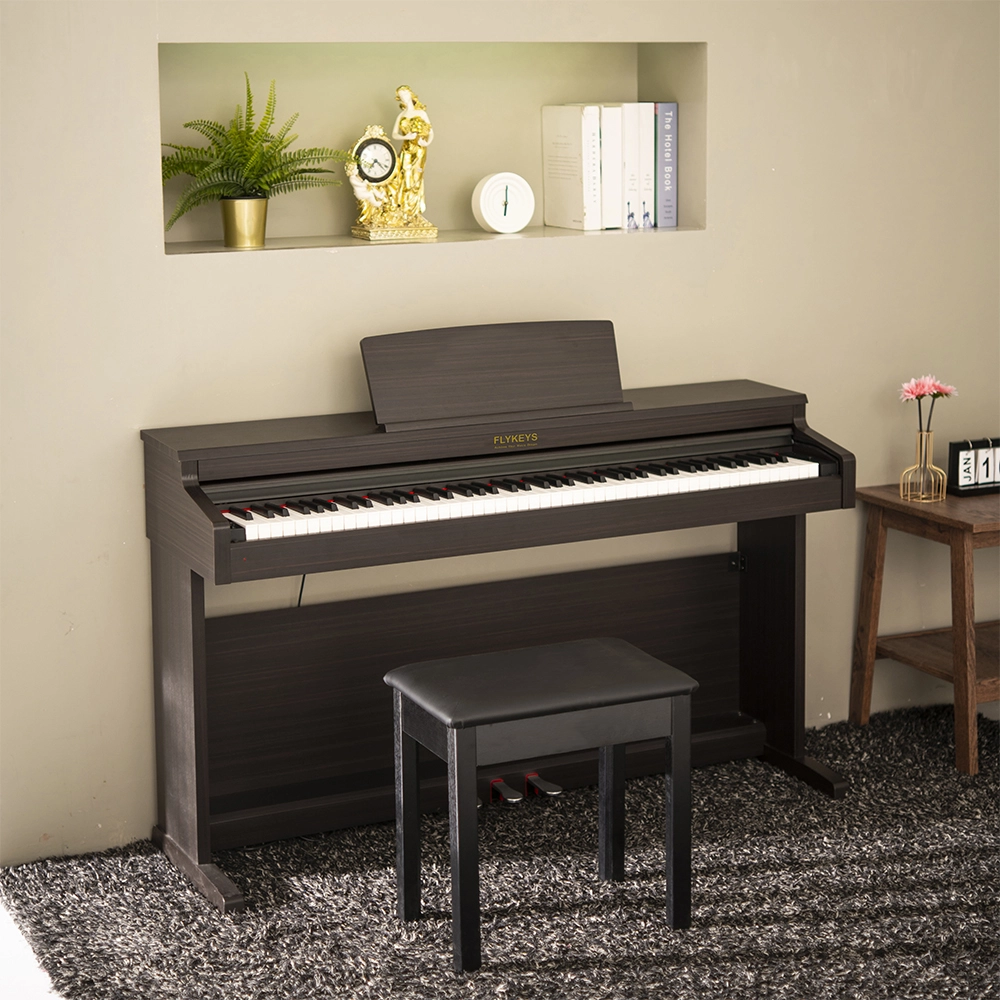
— Standard Upright Digital Piano
— Independent patented technology 88-key Grand-Response hammer-action & dynamic curve keyboard
— European top DSP chip, famous grand piano sound sample
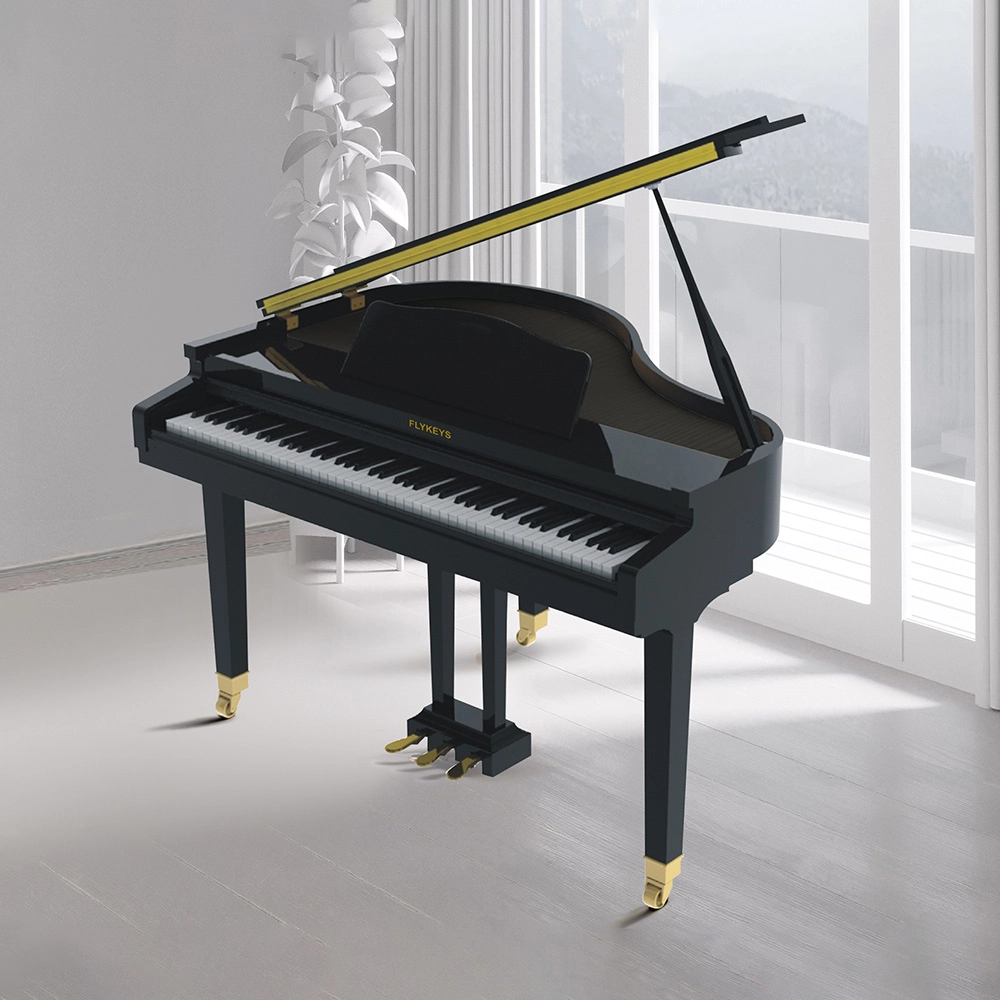
• Baby Grand Style with High-Gloss Polished Cabinet
• Italian Fatar 88-key Grand-Response™ Keyboard with Hammer Action and Touch Curve
• Independently Developed DSP Chip with German Grand Piano Sound Sampling
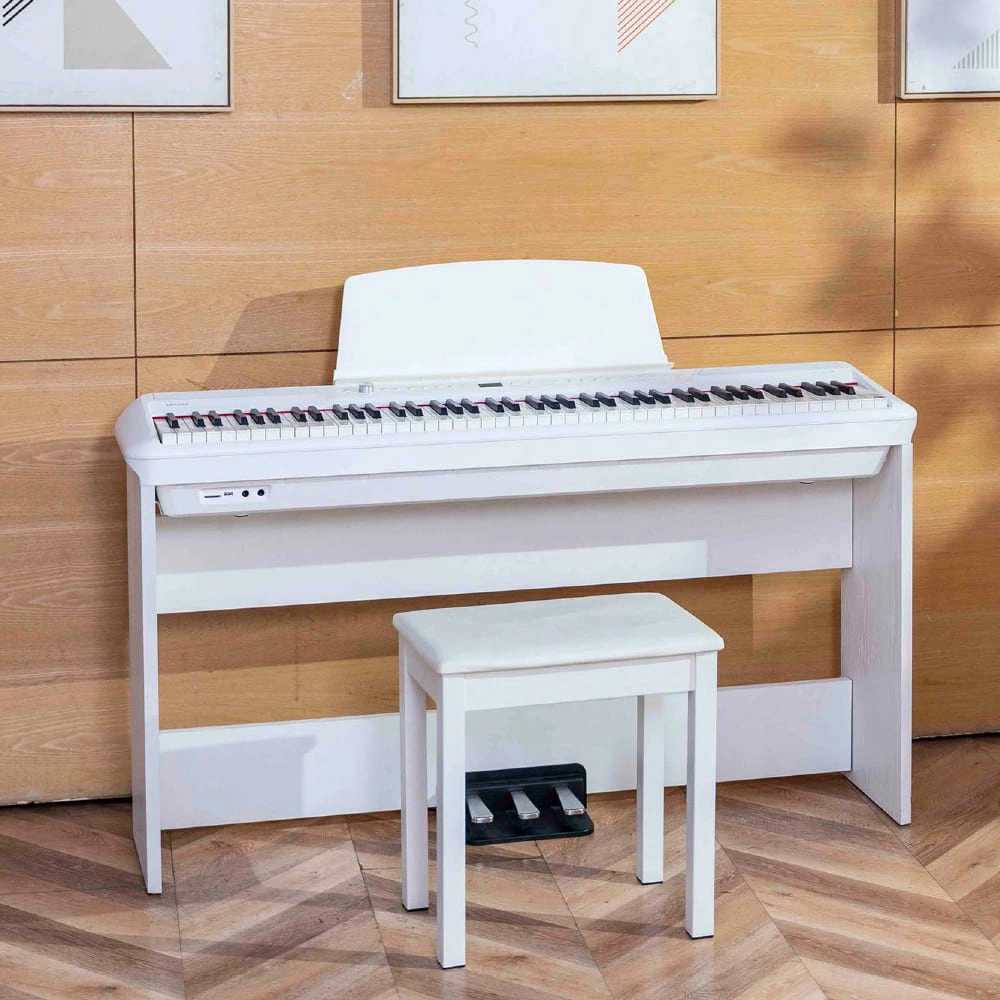
—keyboard: Independent patented technology 88-key, Grand-Response hammer dynamic curve keyboard
—Sound source: Independently developed the 4th generation DSP sound source, German famous grand piano sound sample
— Modern, lightweight case, X stand, U stand, Wood stand, 3 pedals
— Control: double sound, record, split, transpose, reverb, chorus, metronome, MIDI, bluetooth
Address: No. 38 Xiangshan Avenue, Zengcheng Economic And Technological Development Zone, Guangzhou, China.
FOLLOW US:
Copyright© 2026 FLYKEYS All Rights Reserved. 粤 ICP备2020102774号. Designed by Gooeyun. Sitemap | Privacy | Terms
FLYKEYS
FLYKEYS
flykeys-music
Flykeys Music