

Upright Digital Piano vs Acoustic: Buyer's Guide
Choosing between a traditional acoustic instrument and a modern upright digital piano is one of the most critical decisions an aspiring or experienced musician will ever make. Over my fifteen years as an acoustic technician and digital keyboard consultant, I have evaluated hundreds of instruments to discern where mechanical craftsmanship meets digital evolution. In this guide, I will deconstruct the mechanical action, acoustic resonance, artificial intelligence sound engines, and long-term ownership costs of both instruments so you can determine whether an authentic soundboard or the best upright digital piano fits your musical aspirations, domestic layout, and performance budget.
Acoustic Realism and Key Action Mechanics: Deconstructing the Touch
When pianists sit down at an instrument, their tactile perception immediately evaluates key weight, balance, and escapement. Over my career, I have observed that players develop muscle memory based on how a hammer strikes a string and releases. Understanding these mechanical variations is crucial for making an educated choice.
Mechanical Lever Systems versus Graded Hammer Sensors
An acoustic piano relies on an intricate mechanical action composed of thousands of wooden parts, felt hammers, and dampers. When I press a key on an upright acoustic, a complex lever lifts the damper and propels a felt-covered hammer toward steel strings. This mechanical reality produces a natural resistance and an escapement sensation—a slight notch felt when playing softly. In contrast, even the best upright digital piano must simulate this physical kinetic feedback. High-end digital instruments achieve this through triple-sensor graded hammer action, where lower keys carry heavier weighting than higher registers, mimicking physical hammer mass without maintaining an actual wooden striking assembly inside the cabinet.
Dynamic Velocity Tracking and Expressive Control
Authentic dynamic expression demands that an instrument capture the subtlest gradations of touch, from pianissimo to fortissimo. Acoustic instruments naturally reflect micro-variations in finger speed because the hammer velocity directly correlates to string vibration amplitude. In digital instruments, optical or continuous magnetic sensors measure the exact microsecond transit of each key strike. Under the MIDI Association standards, dynamic velocity resolution has evolved from standard 7-bit quantization to high-resolution continuous controller profiles, enabling modern upright digital instruments to translate nuanced finger articulation into immediate tonal shifts.
Sound Generation, AI Acoustic Modeling, and Resonance Science
The tonal debate between acoustic resonance and digital recreation has evolved dramatically over the last decade. Historically, digital instruments relied purely on static samples, but modern AI-driven modeling has bridged the perceptual gap in unexpected ways.
Sympathetic String Resonance and Soundboard Physics
In traditional acoustic piano engineering, sound is not generated in isolation. When one note sounds, non-struck strings vibrate in sympathy, interacting with the cast-iron plate and spruce soundboard. This phenomenon, known as sympathetic resonance, produces a living, breathing sound field. Early digital instruments failed to reproduce this harmonic complexity. Today, leading manufacturers employ real-time artificial intelligence algorithms and advanced physical modeling that calculate string interaction, cabinet reverberation, and damper lift parameters on the fly, rendering a multi-dimensional acoustic field that rivals the biological warmth of natural felt on wire.
Pure Sampling versus Real-Time Neural Sound Synthesis
Conventional digital sampling captures snapshots of physical pianos recorded in studios at various velocity layers. While pleasant, static PCM sampling can feel sterile across extended performances. Modern acoustic modeling uses deep neural networks trained on millions of physical acoustic vibrations to simulate string tension, hammer hardness degradation, and soundboard dispersion. Groundbreaking research documented in piano acoustics shows that the transient attack of a struck string involves non-linear micro-distortions that static samples miss. Neural synthesis regenerates these micro-variations dynamically, eliminating the artificial looping and dynamic stepping that previously plagued electronic keyboards.
| Comparison Factor | Traditional Approach | AI-Driven Approach |
|---|---|---|
| Sound Generation Architecture | Static stereo multi-velocity sampling with static crossfades | Real-time neural physical modeling of continuous string vibration |
| Sympathetic Resonance Handling | Pre-recorded stationary reverb layers triggered by sustain pedal | Dynamic AI algorithmic calculation of all undamped vibrating strings |
| Action Calibration & Drift | Fixed mechanical sensor thresholds vulnerable to physical wear | Self-calibrating optical sensors utilizing AI to compensate for play wear |
| Cabinet Acoustic Dispersion | Unidirectional standard dual-cone speaker output | Multi-channel spatial audio positioning driven by acoustic environment analysis |
Maintenance, Practical Usability, and Environmental Resilience
While sonic fidelity is fundamental, the day-to-day realities of instrument ownership often dictate the ultimate purchasing decision. My consultancy work frequently involves helping homeowners evaluate humidity control, space limitations, and ongoing maintenance investments.
Tuning Stability, Climate Sensitivity, and Long-Term Costs
An acoustic piano is essentially a massive wooden box under thousands of pounds of string tension. Environmental shifts in humidity and ambient temperature cause the soundboard to swell and contract, detuning strings and warping action felts. Most acoustic pianos require professional tuning twice annually, alongside regulation and voicing every few years. An upright digital piano, conversely, will never go out of tune. Its pitch stability remains absolute regardless of seasonal changes, eliminating hundreds of dollars in annual maintenance while safeguarding your domestic peace of mind.
Volume Attenuation, Silent Rehearsal, and Living Space Integration
Acoustic uprights radiate sound uninhibited at 70 to 95 decibels, creating inevitable friction in apartment buildings and shared households. Digital uprights resolve this completely through master volume dials and dual headphone outputs. During late-night practice sessions, modern digital systems reproduce binaural audio that accurately mimics spatial soundboard positioning through headphones, allowing the player to immerse themselves in concert grand dynamics without disturbing family members or neighbors.
Selecting the Right Instrument: Why Our Engineering Stands Apart
Throughout my career evaluating instruments across the global market, I have witnessed how thoughtful engineering transforms the musician's experience. Our enterprise focuses on delivering professional acoustic fidelity through intelligent, modern digital architecture. Whether you are seeking a flexible Portable Digital Piano for traveling performances, an authentic Upright Digital Piano for domestic study, an expansive Grand Digital Piano for concert settings, or feature-rich Keyboards for modern studio production, our technical framework ensures unmatched responsiveness.
Our instruments incorporate multi-sensor hammer action, spatial array amplification, and proprietary AI acoustic modeling algorithms that emulate the complete tonal behavior of acoustic soundboards. By balancing mechanical craftsmanship with cutting-edge signal processing, we eliminate the tuning hassles and environmental vulnerability of traditional acoustic designs while delivering the expressive depth demanded by classical and contemporary pianists alike. Investing in our instruments guarantees an enduring balance of acoustic authenticity and modern functional convenience.
Connect with our piano specialists today to receive a personalized instrument recommendation tailored to your playing style, acoustic preferences, and domestic space.
Frequently Asked Questions
Can the best upright digital piano truly replicate the touch of an acoustic piano?
Yes, premium upright digital pianos utilize triple-sensor graded hammer action mechanisms, wooden keys, and synthetic ivory keytops to recreate the resistance, inertia, and escapement of an authentic acoustic piano.
How often does an upright digital piano require professional calibration or tuning?
An upright digital piano uses digital sound engines and physical sensors rather than tensioned strings, meaning it never requires physical tuning or climatic regulation throughout its operating lifespan.
What are the primary advantages of an upright digital piano over an acoustic in small living spaces?
Digital uprights feature smaller footprints, weigh significantly less than their acoustic counterparts, offer silent headphone practice, and maintain complete pitch stability despite ambient temperature shifts.
Does an upright digital piano support modern studio production and computer connectivity?
Yes, modern upright digital pianos include USB-MIDI, continuous controller output, and multi-channel audio interfaces, making them seamlessly compatible with digital audio workstations and virtual instrument software.
How does AI acoustic modeling improve upon standard digital piano sampling?
AI acoustic modeling computes soundboard reverberation, damper resonance, and sympathetic string vibrations dynamically in real time, rather than playing back flat pre-recorded audio files.
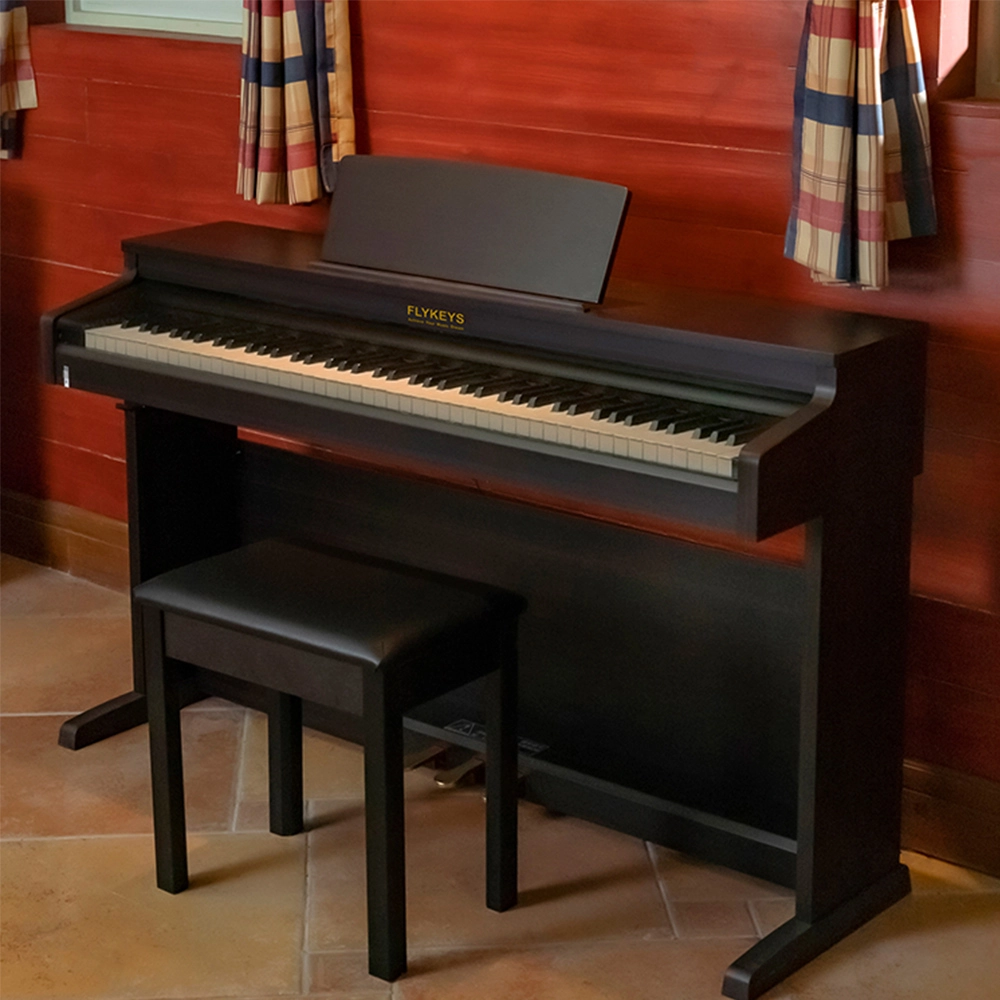
Sound Source: Independently developed DSP chip, famous German grand piano sound samples, 8-layer 256 MB dynamic wavetable, and string resonance and overtone simulation technology.
Keyboard: Independently developed 88-key weighted hammer-action keyboard with dynamic velocity curves.
Exterior: Small door design, wooden cabinet structure, sliding key cover, aluminum alloy handle, foldable large music stand, and side control panel with single-row round buttons.
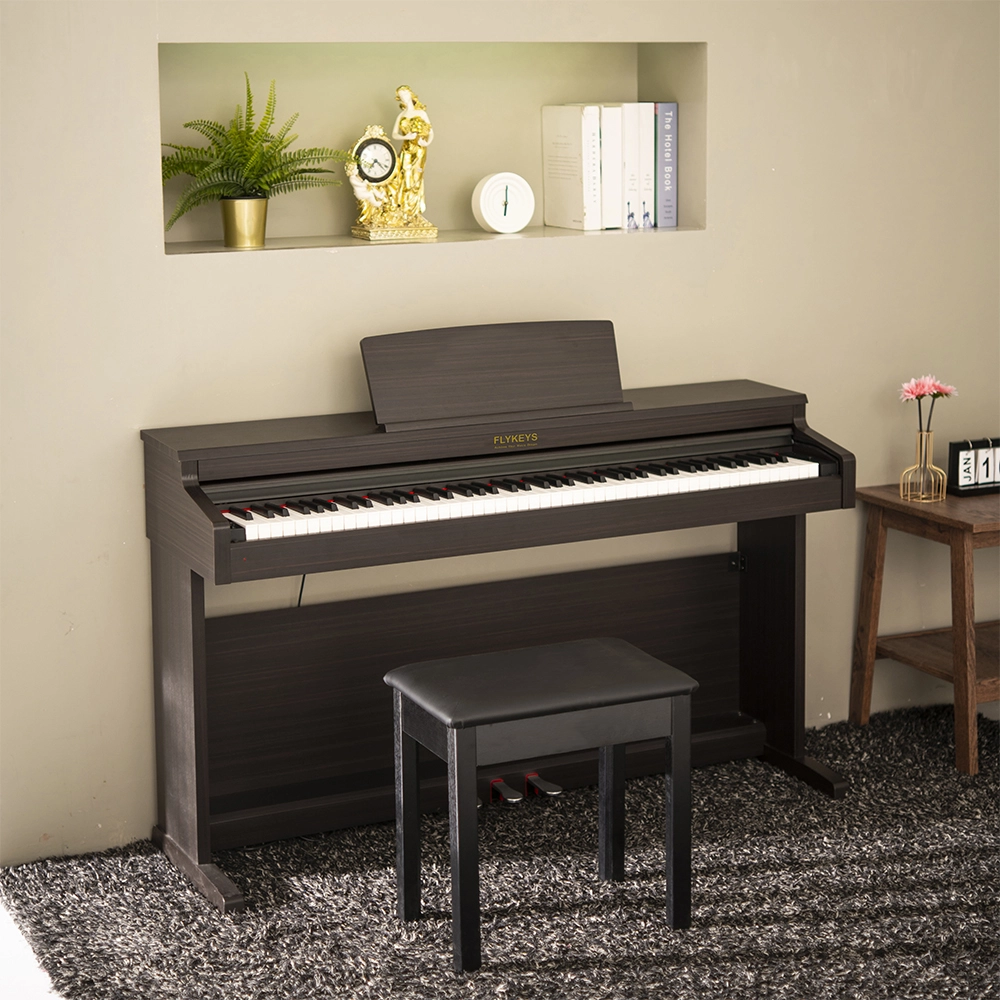
— Standard Upright Digital Piano
— Independent patented technology 88-key Grand-Response hammer-action & dynamic curve keyboard
— European top DSP chip, famous grand piano sound sample
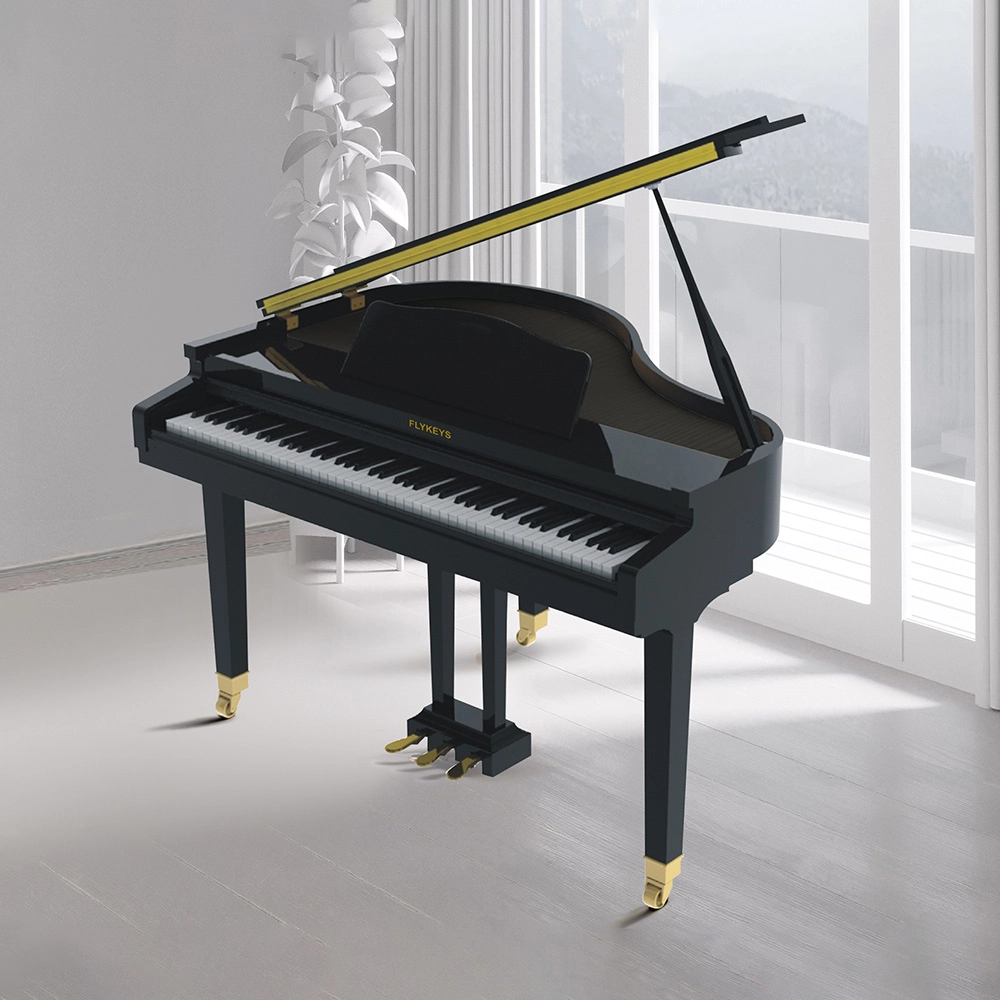
• Baby Grand Style with High-Gloss Polished Cabinet
• Italian Fatar 88-key Grand-Response™ Keyboard with Hammer Action and Touch Curve
• Independently Developed DSP Chip with German Grand Piano Sound Sampling
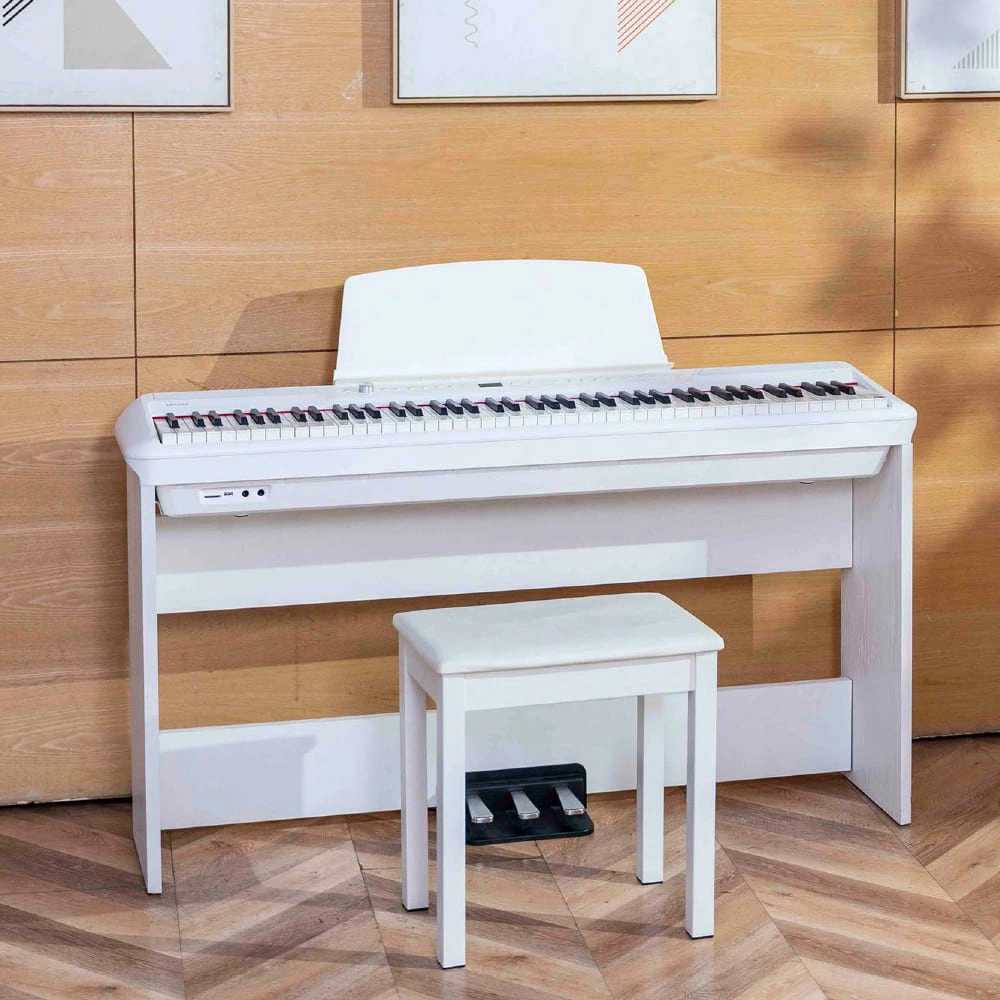
—keyboard: Independent patented technology 88-key, Grand-Response hammer dynamic curve keyboard
—Sound source: Independently developed the 4th generation DSP sound source, German famous grand piano sound sample
— Modern, lightweight case, X stand, U stand, Wood stand, 3 pedals
— Control: double sound, record, split, transpose, reverb, chorus, metronome, MIDI, bluetooth
Address: No. 38 Xiangshan Avenue, Zengcheng Economic And Technological Development Zone, Guangzhou, China.
FOLLOW US:
Copyright© 2026 FLYKEYS All Rights Reserved. 粤 ICP备2020102774号. Designed by Gooeyun. Sitemap | Privacy | Terms
FLYKEYS
FLYKEYS
flykeys-music
Flykeys Music